Advertisements
Advertisements
प्रश्न
What will happen if we kill all the organisms in one trophic level?
Advertisements
उत्तर
If we kill all the organisms in one trophic level, there will be no food for the organisms of the next trophic level, and they will die of starvation. Also, the organisms of the previous trophic levels will increase in number as there will be no organism to consume them as food.
APPEARS IN
संबंधित प्रश्न
"Energy flow in a food chain is unidirectional" Justify this statement.
We do not clean natural ponds or lakes but an aquarium needs to be cleaned regularly. Why is it so ? Explain.
Explain the term ‘producer’.
Name one decomposer.
Consider the food chain :
Grass → Deer → Lion
What will happen if all the lions are removed from the above food chain?
Write down a food chain in the sea.
Construct a short foodchain, ending with man.
In a food chain, the initial organism is usually :
(a) photosynthetic
(b) herbivore
(c) saprophytic
(d) parasitic
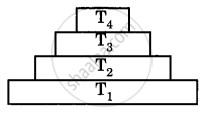
In the figure given alongside, the various trophic levels are shown in the form of a pyramid. At which trophic level the maximum energy is available?
The sea water contains water beetles, tadpole, fish and weeds.
Which organisms can trap solar energy to make food?
The following is a food chain that ends with human :
How does this food chain differ form a usual food chain involving human such as : plants → goat → human?
A food chain occurring in the sea which provides food for many people can be written as :
phytoplankton → zooplankton → X → Y
Name two zooplanktons.
Write the percentage of energy transferred from autotrophs to the next level in a food chain.
Fill in the following blank with suitable word :
Plants → Antelope → ............
The surface of water in a lake appears green due to a layer of tiny free-floating organisms X on its surface. The lake water also contains organisms like water beetle, fish and tadpole. The sun shines over the lake water and provides energy for the functioning of this lake ecosystem.
(a) What could organisms X be?
(b) Write a food chain comprising of all the four organisms mentioned.
(c) What is the general name of the food chains like the one written above?
(d) Name (i) secondary consumer (ii) producer (iii) tertiary consumer, and (iv) primary consumer, in the above food chain.
(e) If the tertiary consumer gets 0.2 J of energy from the secondary consumer, then how much energy was radiated by the sun to the producer?
What are decomposers? What will be the consequence if the decomposers are completely eradicated from an ecosystem? Give justification in support of your answer.
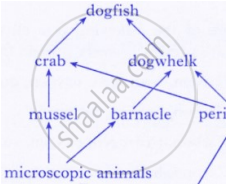
Observe the food web and answer the questions given below:
Why do all food chains start with plants?
Analogy:
Primary Consumer: Goat, Cow:: Secondary Consumer: ______.
According to the 10% law, if producers in an ecosystem have 10,000 units of energy, approximately how much energy is available to primary consumers?
If a secondary consumer receives 100 units of energy from primary consumers, how much energy approximately originated from the producers?
