Advertisements
Advertisements
प्रश्न
Advertisements
उत्तर
The turning effect produced by a force on a rigid body about a point, pivot or fulcrum is called the moment of force or torque. It is measured by the product of force and the perpendicular distance of the pivot from the line of action of force.
Examples of turning effect of force:
(i) Turning a steering wheel
(ii) Tightening a cap
APPEARS IN
संबंधित प्रश्न
A nut is opened by a wrench of length 20 cm. If the least force required is 2N, find the moment of force needed to loosen the nut.
Match the column
| Column A | Column B |
| (a) Camel | (1) broad and deep foundation |
| (b) Truck | (2) broad feet |
| (c) Knife | (3) six or eight tyres |
| (d) High building | (4) sharp cutting edge |
| (e) Thrust | (5) atm |
| (f) Moment of force | (6) N |
| (g) Atmospheric pressure | (7) N m |
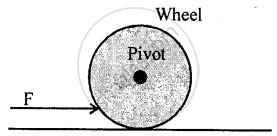
State the effect of force F in of the following diagram.
State one factor on which the magnitude of a non-contact force depends. How does it depend on the factor stated by you?.
A body X of mass 5 kg is moving with velocity 20 m s-2 while another body Y of mass 20 kg is moving with velocity 5 m S-1. Compare the momentum of the two bodies.
Give two examples of a couple's actions in our daily life.
One joule is the amount of work done when a force of ......... moves a body through a distance of .......
A jack screw is provided with a long arm. Explain why?
The diagram shows wheel O pivoted at point A. Three equal forces F1, F2 and F3 act at point B on the wheel.

- Which force will produce maximum moment about A?
- Give a reason for your answer in (a).
