Advertisements
Advertisements
प्रश्न
What makes respiration and blood circulation go on all the time, and the processes of digestion happen at the right time?
Advertisements
उत्तर
All the systems and their functioning is under the control and coordination of the brain. The brain keeps all the processes working in normally functioning body.
APPEARS IN
संबंधित प्रश्न
What substance is mixed with food in the mouth during chewing by the teeth?
Describe one way in which the small intestine is adapted for the absorption of digested food.
Which part of alimentary canal receives bile from the liver?
| When a person eats sugary food, then organisms A present in his mouth act on sugar to produce a substance B. The substance B first dissolves the calcium salts from the top part C of the tooth and then from its middle part D forming holes E. These holes ultimately reach the part F in the lower part of tooth which contains nerves and blood vessels. The substance B irritates the nerve endings inside the tooth causing toothache. |
- What are (i) organisms A, and (ii) substance B?
- What are (i) part C, and (ii) part D, of tooth known as?
- By what name are the holes E in the tooth known?
- Name the part F of the tooth.
- What will happen if organisms A reach part F of the tooth known?
List in tabular form two differences between pepsin and trypsin.
Mark odd one in the series:
How do we know that we are hungry and that we should now eat?
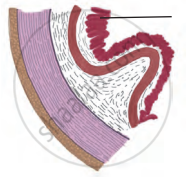
Observe the diagram. This is the histological structure of the stomach. Identify and comment on the significance of the layer marked by an arrow.
Eating fast-food ad junk food affects our health. Justify.
Which part of the alimentary canal receives bile from the liver?
