Advertisements
Advertisements
प्रश्न
What is the significance of double circulation?
Advertisements
उत्तर १
It includes systemic circulation and pulmonary circulation. The circulatory pathway of double circulation is given in the following flow chart.
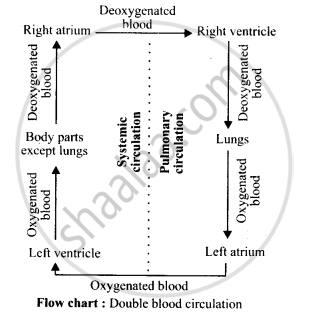
Double blood circulation
Double circulation or separation of systemic and pulmonary circulations, provides a higher metabolic rate to the body and also allows the two circulations to have different blood pressures according to the need of the organs they supply
उत्तर २
- Deoxygenated blood from different parts of the body is collected into the right atrium by the great veins. When the right atrium contracts, it passes into the right ventricle. When the right ventricle contracts, this deoxygenated blood passes through the pulmonary artery into the pleura (lungs), where gases are exchanged.
- This blood gets oxygenated and returns to the left atrium of the heart through the pulmonary veins. When the left atrium contracts, this oxygenated blood comes into the left ventricle.
- When the left ventricle contracts, this blood is distributed through the aorta to different parts of the body.

Therefore, the same blood passes through the heart twice in the cardiac cycle, once as oxygenated and a second time as deoxygenated blood. This is called double circulation.
Our heart is made up of four chambers, due to which oxygenated blood is distributed to all parts of our body. Due to this, oxygen distribution in cells and tissues remains as per requirement.
APPEARS IN
संबंधित प्रश्न
What is meant by the term ‘single circulation’?
What is the difference between pulmonary circulation and systemic circulation?
Blood in the human body circulates twice for making one complete round through the body. Explain.
Differentiate between the following pair of terms: Pulmonary artery and pulmonary vein
What does the term ‘double circulation’ mean?
The diagram represents the ‘closed system’ or ‘double circulation’ of blood in mammals.
Justify the above statement.
State two structural and two functional differences between the arteries and veins.
State the changes in the composition of blood as it passes through the following organs:
(a) Lungs (b) Gut (c) Liver (d) Kidneys.
State the Location: Hepatic portal vein
Why is the circulation in man referred to as double circulation?
In which of the following groups of organisms, blood flows through the heart only once during one cycle of passage through the body?
Why is the small intestine in herbivores longer than in carnivores?
Which of the following carries nutrients from the digestive tract to the liver?
Explain the advantage of the complete partition of ventricle among birds and mammals and hence leading to double circulation.
Describe the events in cardiac cycle. Explain “double circulation”.
Complete the following flow diagram of double circulation:

Why is the double circulation of blood in human beings necessary?
Choose the odd one out from the following terms and name the category to which the others belong:
Name these:
Two phases of circulation of blood in human body
Write important role/roles of the following:
Hepatic portal vein
Write the exact location of the following:
Hepatic portal vein
