Advertisements
Advertisements
प्रश्न
What is the resistance, under normal working conditions, of an electric lamp rated at '240 v, 60 W' ? If two such lamps are connected in series across a 240 V mains supply, explain why each one appears less bright.
Advertisements
उत्तर
Given voltage, V = 240 V
Power, P = 60 W
As P = `"V"^2/"R"`
∴ R = `(240)^2/60`
= 960 Ω
I = `"P"/"V"` = 0.25 A
When one lamp is connected across the mains, it draws 0.25 A current, while if two lamps are connected in series across the mains, current through each bulb becomes
`(240 "V")/((960 + 960) Omega) = 0.125 "A"`
(i.e., current is halved), hence heating (= I2Rt) in each bulb becomes one-fourth, so each bulb appears less bright.
APPEARS IN
संबंधित प्रश्न
All electrical appliances in a household circuit work at the same voltage.
The unit in which we pay the cost of electricity is ..........
In a household electrical circuit, the appliance are connected in ............with the mains.
One kilowatt is equal to
What is an electric meter? Where is it fixed in our house?
The diagram below in figure shows the reading on the dials of a meter. State what is its reading.
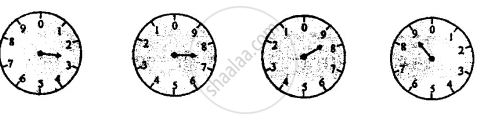
In a premise 5 bulbs each of 100 W, 2 fans each of 60 W, 2 A.Cs each of 1.5 kW is used for 5 h per day. Find:
- Total power consumed per day,
- Total power consumed in 30 days,
- Total electrical energy consumed in 30 days.
- The cost of electricity at the rate of ₹ 6.25 per unit.
State and define the household unit of electricity.
What is the voltage of the electricity that is generally supplied to a house?
Our body can pass electricity through it.
