Advertisements
Advertisements
प्रश्न
What do sex linked traits appear in males than in females?
Advertisements
उत्तर
Sex linked traits are more common in males and females this is because a recessive alleles in the X chromosome and producers the trait in the male.
APPEARS IN
संबंधित प्रश्न
Write the scientific name of the fruit-fly. Why did Morgan prefer to work with fruit-flies for his experiments? State any three reasons.
Identify ‘a’, ‘b’, ‘c’, ‘d’, ‘e’ and ‘f’ in the table given below:
| S. No. | Syndrome | Cause | Characteristics of affected individuals | Sex (male/female/both) |
| 1. | Down’s | Trisomy of 21 |
‘a’ |
‘b’ |
| 2. | ‘c’ | XXY | Overall masculine development | ‘d’ |
| 3. | Turner’s | 45 with XO |
‘e’ |
‘f’ |
Which of the following characteristics are observed in a person suffering from Turner syndrome?
Select the incorrect statement regarding pedigree analysis.
Females with Turner’s syndrome have ______.
Placed below is a karyotype of a human being.
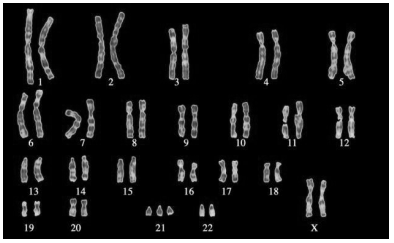
On the basis of this karyotype, which of the following conclusions can be drawn: ______
Read the following and answer from given below:
According to Mendel, one gene controls the expression of one character only. The ability of a gene to have multiple phenotypic effects because it influences a number of characters are an exception. The gene has multiple phenotypic effects because its ability to control two or more characters can be seen in cotton. In cotton, a gene for the lint also influences the height of the plant, size of the ball, number of ovules, and viability of seeds.
Which of the following disorder is an example of genes with multiple phenotypic effects?
Identify chromosomal disorder caused due to non-disjunction of the 21st number of chromosomes and enlist its symptoms.
Select the correct match.
Describe Turner's syndrome.
