Advertisements
Advertisements
प्रश्न
We can see a non-luminous object when the light
पर्याय
emitted by the object falls on the eye
is reflected from the object towards our eye
completely passes through the object
gets completely absorbed by the object
Advertisements
उत्तर
is reflected from the object towards our eye
Explanation:
We can see a non-luminous object (object that does not produce its own light), when light reflected by the object enters our eyes.
APPEARS IN
संबंधित प्रश्न
Fill in the blank
Angle of incidence = ___________
Fill in the blank
The incident ray, the reflected ray and the normal lie in one _______
Select the correct alternative
The angle of incidence on a plane mirror is 30°.The angle of reflection will be:
Select the correct alternative
The angle of incidence on a plane mirror is 30°. The angle between the incident ray and the reflected ray is
A ray of light falls normally on a plane mirror. What is the angle of incidence ?
In the following diagrams, measure and write the angle of incidence and draw the reflected ray in a given case.

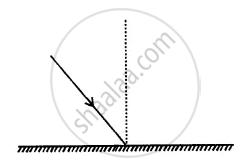
In the following diagram, measure and write the angle of incidence and draw the reflected ray.
Define the following term
Incident ray
Two mirrors A and B are placed at right angles to each other as shown in the following figure.

A ray of light incident on mirror A at an angle of 25° falls on mirror B after reflection. The angle of reflection for the ray reflected from mirror B would be
Angle of incidence is greater than the angle of reflection.
