Advertisements
Advertisements
प्रश्न
Using the Reminder Theorem, factorise of the following completely.
2x3 + x2 – 13x + 6
Advertisements
उत्तर
Let f (x) = 2x3 + x2 − 13x + 6
For x = 2,
f(x) = f(2) = 2(2)3 + (2)2 − 13(2) + 6 = 16 + 4 − 26 + 6 = 0
Hence, (x − 2) is a factor of f(x).
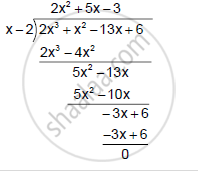
∴ `2x^3 + x^2 - 13x + 6 = (x-2) (2x^2 + 5x -3)`
= `(x-2)(2x^2 + 6x -x -3)`
= `(x-2) [2x(x + 3) -(x-3)]`
=` (x - 2)(x + 3) (2x - 1)`
संबंधित प्रश्न
Given that x – 2 and x + 1 are factors of f(x) = x3 + 3x2 + ax + b; calculate the values of a and b. Hence, find all the factors of f(x).
If the polynomials ax3 + 4x2 + 3x - 4 and x3 - 4x + a leave the same remainder when divided by (x - 3), find the value of a.
In the following two polynomials, find the value of ‘a’ if x – a is a factor of each of the two:
x6 - ax5 + x4 - ax3 + 3a + 2
If x – 2 is a factor of each of the following three polynomials. Find the value of ‘a’ in each case:
x3 + 2ax2 + ax - 1
If x – 2 is a factor of each of the following three polynomials. Find the value of ‘a’ in each case:
x5 - 3x4 - ax3 + 3ax2 + 2ax + 4.
When 3x2 – 5x + p is divided by (x – 2), the remainder is 3. Find the value of p. Also factorise the polynomial 3x2 – 5x + p – 3.
Use factor theorem to factorise the following polynomials completely: 4x3 + 4x2 – 9x – 9
Use factor theorem to factorise the following polynomials completely: x3 – 19x – 30
If (2x + 1) is a factor of both the expressions 2x2 – 5x + p and 2x2 + 5x + q, find the value of p and q. Hence find the other factors of both the polynomials.
The polynomial 3x3 + 8x2 – 15x + k has (x – 1) as a factor. Find the value of k. Hence factorize the resulting polynomial completely.
