मराठी

Using the Property of Determinants and Without Expanding, Prove That: |(B+C, Q+R, Y+Z),(C+A, R+P, Z +X),(A+B, P+Q, X + Y )| = 2|(A,P,X),(B,Q,Y),(C, R,Z)| - Mathematics

Advertisements
Advertisements

प्रश्न

Using the property of determinants and without expanding, prove that:

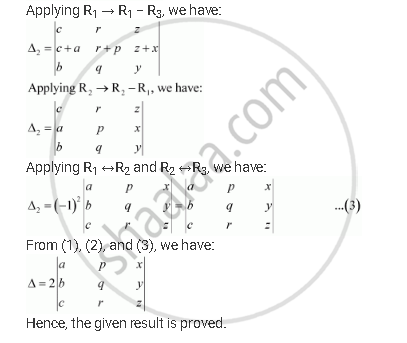
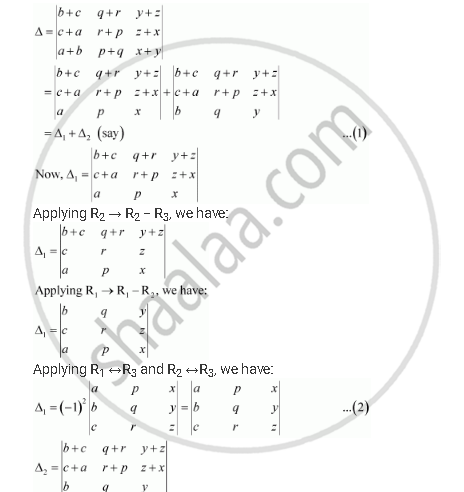
`|(b+c, q+r, y+z),(c+a, r+p, z +x),(a+b, p+q, x + y )| = 2|(a,p,x),(b,q,y),(c, r,z)|`

Advertisements

उत्तर
shaalaa.com
  या प्रश्नात किंवा उत्तरात काही त्रुटी आहे का?
पाठ 4: Determinants - Exercise 4.2 [पृष्ठ ११९]

APPEARS IN

एनसीईआरटी Mathematics Part 1 and 2 [English] Class 12
पाठ 4 Determinants
Exercise 4.2 | Q 5 | पृष्ठ ११९

संबंधित प्रश्‍न

Using properties of determinants, prove that `|[2y,y-z-x,2y],[2z,2z,z-x-y],[x-y-z,2x,2x]|=(x+y+z)^3`


Using properties of determinants prove the following: `|[1,x,x^2],[x^2,1,x],[x,x^2,1]|=(1-x^3)^2`


Using properties of determinants, show that ΔABC is isosceles if:`|[1,1,1],[1+cosA,1+cosB,1+cosC],[cos^2A+cosA,cos^B+cosB,cos^2C+cosC]|=0​`


By using properties of determinants, show that:

`|(1,a,a^2),(1,b,b^2),(1,c,c^2)| = (a - b)(b-c)(c-a)`


Without expanding the determinant, prove that

`|(a, a^2,bc),(b,b^2, ca),(c, c^2,ab)| = |(1, a^2, a^3),(1, b^2, b^3),(1, c^2, c^3)|`


Using properties of determinants show that

`[[1,1,1+x],[1,1+y,1],[1+z,1,1]] = xyz+ yz +zx+xy.`


Using properties of determinants, prove that:

`|(a,b,b+c),(c,a,c+a),(b,c,a+b)|` = (a+b+c)(a-c)2 


Evaluate the following determinants:

`|(x - 1, x, x - 2),(0, x - 2, x - 3),(0, 0, x - 3)| = 0`


If `|(4 + x, 4 - x, 4 - x),(4 - x, 4 + x, 4 - x),(4 - x, 4 - x, 4 + x)|` = 0, then find the values of x.


Without expanding the determinant, find the value of `|(10, 57, 107),(12, 64, 124),(15, 78, 153)|`.


Find the value (s) of x, if `|(1, 2x, 4x),(1, 4, 16),(1, 1, 1)|` = 0


Without expanding the determinants, show that `|("b" + "c", "bc", "b"^2"c"^2),("c" + "a", "ca", "c"^2"a"^2),("a" +  "b", "ab", "a"^2"b"^2)|` = 0


Without expanding evaluate the following determinant:

`|(2, 3, 4),(5, 6, 8),(6x, 9x, 12x)|`


Select the correct option from the given alternatives:

`|("b" + "c", "c" + "a", "a" + "b"),("q" + "r", "r" + "p", "p" + "q"),(y + z, z + x, x + y)|` = 


Answer the following question:

Without expanding determinant show that

`|(l, "m", "n"),("e", "d", "f"),("u", "v", "w")| = |("n", "f", "w"),(l, "e", "u"),("m", "d", "v")|`


The value of `|(1, 1, 1),(""^"n""C"_1, ""^("n" + 2)"C"_1, ""^("n" + 4)"C"_1),(""^"n""C"_2, ""^("n" + 2)"C"_2, ""^("n" + 4)"C"_2)|` is 8.


Evaluate: `|(x^2 - x + 1, x - 1),(x + 1, x + 1)|`


Evaluate: `|(0, xy^2, xz^2),(x^2y, 0, yz^2),(x^2z, zy^2, 0)|`


Prove that: `|(y^2z^2, yz, y + z),(z^2x^2, zx, z + x),(x^2y^2, xy, x + y)|` = 0


The number of distinct real roots of `|(sinx, cosx, cosx),(cosx, sinx, cosx),(cosx, cosx, sinx)|` = 0 in the interval `pi/4  x ≤ pi/4` is ______.


If A, B and C are angles of a triangle, then the determinant `|(-1, cos"C", cos"B"),(cos"C", -1, cos"A"),(cos"B", cos"A", -1)|` is equal to ______.


The value of the determinant `|(x , x + y, x + 2y),(x + 2y, x, x + y),(x + y, x + 2y, x)|` is ______.


`|(x + 1, x + 2, x + "a"),(x + 2, x + 3, x + "b"),(x + 3, x + 4, x + "c")|` = 0, where a, b, c are in A.P.


The determinant `abs (("a","bc","a"("b + c")),("b","ac","b"("c + a")),("c","ab","c"("a + b"))) =` ____________


Let P be any non-empty set containing p elements. Then, what is the number of relations on P?


A system of linear equations represented in matrix form Ax = 0, A is n × n matrix, has a non-zero solution if the determinant of A (i.e., det(A)) is


Let 'A' be a square matrix of order 3 × 3, then |KA| is equal to:


In a triangle the length of the two larger sides are 10 and 9, respectively. If the angles are in A.P., then the length of the third side can be ______.


If f(α) = `[(cosα, -sinα, 0),(sinα, cosα, 0),(0, 0, 1)]`, prove that f(α) . f(– β) = f(α – β).


Without expanding determinants find the value of `|(10, 57, 107),(12, 64, 124),(15, 78, 153)|`


Evaluate the following determinant without expanding:

`|(5, 5, 5),(a, b, c),(b + c, c + a, a + b)|`


By using properties of determinants, prove that 

`|(x+y, y+z, z+x),(z, x, y),(1, 1, 1)|` = 0 


Without expanding evaluate the following determinant.

`|(1,"a","b+c"),(1,"b","c+a"),(1,"c","a+b")|`


Without expanding determinants, find the value of `|(10, 57, 107),(12, 64, 124),(15, 78, 153)|`


Without expanding evaluate the following determinant.

`|(1, a, b + c),(1, b, c + a),(1, c, a + b)|`


Share
Notifications

Englishहिंदीमराठी


      Forgot password?
Use app×