Advertisements
Advertisements
प्रश्न
Using integration, find the area of the triangle ABC coordinates of whose vertices are A (4, 1), B (6, 6) and C (8, 4).
Advertisements
उत्तर
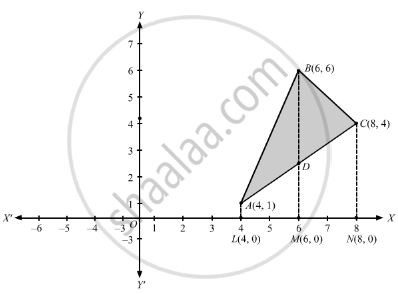
A(4, 1), B(6, 6) and C(8, 4) are three given points.
Equation of AB is given by
\[y - 1 = \frac{6 - 1}{6 - 4}\left( x - 4 \right)\]
\[ \Rightarrow y - 1 = \frac{5}{2}\left( x - 4 \right)\]
\[ \Rightarrow y = \frac{5}{2}x - 9 . . . . . \left( 1 \right)\]
Equation of BC is given by
\[y - 6 = \frac{4 - 6}{8 - 6} \left( x - 6 \right)\]
\[ \Rightarrow y - 6 = - \left( x - 6 \right)\]
\[ \Rightarrow y = - x + 12 . . . . . \left( 2 \right)\]
Equation of CA is given by
\[ \Rightarrow y - 4 = \frac{1 - 4}{4 - 8}\left( x - 8 \right)\]
\[ \Rightarrow y - 4 = \frac{3}{4}\left( x - 8 \right)\]
\[ \Rightarrow y = \frac{3}{4}x - 2 . . . . . \left( 3 \right)\]
Required area of shaded region ABC
\[\text{ Shaded area }\left( ABC \right) = \text{ area }\left( ABD \right) \hspace{0.167em} + area\left( DBC \right)\]
\[\text{ Consider a point }P\left( x, y_2 \right)\text{ on AB and }Q\left( x, y_1 \right)\text{ on AD }\]
\[ \Rightarrow\text{ for a vertical strip of length }= \left| y_2 - y_1 \right|\text{ and width }= dx, \text{ area }= \left| y_2 - y_1 \right|dx, \]
\[\text{ The approximating rectangle moves from } x = 4\text{ to }x = 6\]
\[\text{ Hence area }\left( ABD \right) = \int_4^6 \left| y_2 - y_1 \right|dx\]
\[ = \int_4^6 \left[ \left( \frac{5}{2}x - 9 \right) - \left( \frac{3}{4}x - 2 \right) \right]dx\]
\[ = \int_4^6 \left( \frac{7}{4}x - 7 \right)dx\]
\[ = \left[ \frac{7}{4} \times \frac{x^2}{2} - 7x \right]_4^6 \]
\[ = \frac{7}{8}\left( 36 - 16 \right) - 7\left( 6 - 4 \right)\]
\[ = \frac{7}{8} \times 20 - 14\]
\[ = \frac{35}{2} - 14\]
\[ = \frac{35 - 28}{2} = \frac{7}{2}\text{ sq units }\]
\[\text{ Consider a point S }\left( x, y_4 \right)\text{ on BC and R }\left( x, y_3 \right)\text{ on DC }\]
\[\text{ For a vertical strip of length }= \left| y_4 - y_3 \right|\text{ and width }= dx, \text{ area }= \left| y_4 - y_3 \right|dx, \]
\[\text{ The approximating rectangle moves from }x = 6\text{ to } x = 8\]
\[ \Rightarrow \text{ area }\left( BDC \right) = \int_6^8 \left[ \left( - x + 12 \right) - \left( \frac{3}{4}x - 2 \right) \right] dx\]
\[ = \int_6^8 \left( - \frac{7}{4}x + 14 \right)dx\]
\[ = \left[ - \frac{7}{4} \times \frac{x^2}{2} + 14x \right]_6^8 \]
\[ = \left[ - \frac{7 x^2}{8} + 14x \right]_6^8 \]
\[ = - \frac{7}{8}\left( 64 - 36 \right) + 14\left( 8 - 6 \right)\]
\[ = - \frac{7}{8} \times 28 + 28\]
\[ = \frac{28}{8} = \frac{7}{2}\]
\[\text{ Thus required area }\left( ABC \right) = \frac{7}{2} + \frac{7}{2} = 7 \text{ sq . units }\]
APPEARS IN
संबंधित प्रश्न
Find the area of the region bounded by the parabola y2 = 16x and the line x = 3.
Draw a rough sketch of the graph of the curve \[\frac{x^2}{4} + \frac{y^2}{9} = 1\] and evaluate the area of the region under the curve and above the x-axis.
Sketch the region {(x, y) : 9x2 + 4y2 = 36} and find the area of the region enclosed by it, using integration.
Find the area of the region bounded by the curve xy − 3x − 2y − 10 = 0, x-axis and the lines x = 3, x = 4.
Compare the areas under the curves y = cos2 x and y = sin2 x between x = 0 and x = π.
Find the area of the region bounded by the curve \[a y^2 = x^3\], the y-axis and the lines y = a and y = 2a.
Find the area of the region \[\left\{ \left( x, y \right): \frac{x^2}{a^2} + \frac{y^2}{b^2} \leq 1 \leq \frac{x}{a} + \frac{y}{b} \right\}\]
Find the area of the region {(x, y) : y2 ≤ 8x, x2 + y2 ≤ 9}.
Find the area, lying above x-axis and included between the circle x2 + y2 = 8x and the parabola y2 = 4x.
Using the method of integration, find the area of the region bounded by the following lines:
3x − y − 3 = 0, 2x + y − 12 = 0, x − 2y − 1 = 0.
Find the area of the region bounded by the curve y = \[\sqrt{1 - x^2}\], line y = x and the positive x-axis.
Find the area of the region enclosed between the two curves x2 + y2 = 9 and (x − 3)2 + y2 = 9.
Using integration, find the area of the following region: \[\left\{ \left( x, y \right) : \frac{x^2}{9} + \frac{y^2}{4} \leq 1 \leq \frac{x}{3} + \frac{y}{2} \right\}\]
The area bounded by the parabola x = 4 − y2 and y-axis, in square units, is ____________ .
The area of the region formed by x2 + y2 − 6x − 4y + 12 ≤ 0, y ≤ x and x ≤ 5/2 is ______ .
The area of the region bounded by the parabola (y − 2)2 = x − 1, the tangent to it at the point with the ordinate 3 and the x-axis is _________ .
The area bounded by the parabola y2 = 4ax and x2 = 4ay is ___________ .
The area bounded by the curve y = x4 − 2x3 + x2 + 3 with x-axis and ordinates corresponding to the minima of y is _________ .
The area bounded by the curve y2 = 8x and x2 = 8y is ___________ .
The area bounded by the y-axis, y = cos x and y = sin x when 0 ≤ x ≤ \[\frac{\pi}{2}\] is _________ .
Area lying in first quadrant and bounded by the circle x2 + y2 = 4 and the lines x = 0 and x = 2, is
Find the equation of the standard ellipse, taking its axes as the coordinate axes, whose minor axis is equal to the distance between the foci and whose length of the latus rectum is 10. Also, find its eccentricity.
Find the area of region bounded by the line x = 2 and the parabola y2 = 8x
Find the area bounded by the curve y = `sqrt(x)`, x = 2y + 3 in the first quadrant and x-axis.
Compute the area bounded by the lines x + 2y = 2, y – x = 1 and 2x + y = 7.
The area of the region bounded by the ellipse `x^2/25 + y^2/16` = 1 is ______.
Using integration, find the area of the region in the first quadrant enclosed by the line x + y = 2, the parabola y2 = x and the x-axis.
Let f(x) be a continuous function such that the area bounded by the curve y = f(x), x-axis and the lines x = 0 and x = a is `a^2/2 + a/2 sin a + pi/2 cos a`, then `f(pi/2)` =
The area bounded by the curve `y = x|x|`, `x`-axis and the ordinate `x` = – 1 and `x` = 1 is given by
Make a rough sketch of the region {(x, y): 0 ≤ y ≤ x2, 0 ≤ y ≤ x, 0 ≤ x ≤ 2} and find the area of the region using integration.
Find the area of the region enclosed by the curves y2 = x, x = `1/4`, y = 0 and x = 1, using integration.
Let the curve y = y(x) be the solution of the differential equation, `("dy")/("d"x) = 2(x + 1)`. If the numerical value of area bounded by the curve y = y(x) and x-axis is `(4sqrt(8))/3`, then the value of y(1) is equal to ______.
The area (in sq.units) of the region A = {(x, y) ∈ R × R/0 ≤ x ≤ 3, 0 ≤ y ≤ 4, y ≤x2 + 3x} is ______.
Let f : [–2, 3] `rightarrow` [0, ∞) be a continuous function such that f(1 – x) = f(x) for all x ∈ [–2, 3]. If R1 is the numerical value of the area of the region bounded by y = f(x), x = –2, x = 3 and the axis of x and R2 = `int_-2^3 xf(x)dx`, then ______.
Let a and b respectively be the points of local maximum and local minimum of the function f(x) = 2x3 – 3x2 – 12x. If A is the total area of the region bounded by y = f(x), the x-axis and the lines x = a and x = b, then 4A is equal to ______.
Sketch the region bounded by the lines 2x + y = 8, y = 2, y = 4 and the Y-axis. Hence, obtain its area using integration.
Find the area of the minor segment of the circle x2 + y2 = 4 cut off by the line x = 1, using integration.
Hence find the area bounded by the curve, y = x |x| and the coordinates x = −1 and x = 1.
