Advertisements
Advertisements
प्रश्न
Using Huygens's construction, show how a plane wave is reflected from a surface. Hence verify the law of reflection.
Advertisements
उत्तर
Laws of reflection:
- 1st law: It claims that the angle of incidence and angle of reflection are equal.
- 2nd law: According to this statement, the incident ray, the reflected ray, and the incident point normal all lie in the same plane.

The first law of reflection. Let XY be a plane reflecting surface and AB be a plane wavefront incident on the surface as shown in the figure.
According to the Huygens principle, every point on wavefront AB is a source of secondary wavelet and the time during which wavelet from reaches C, the reflected wavelet from A would arrive at D.
i.e. `t = (BC)/v = (AD)/v`
or BC = AD ...............(i)
`v` = velocity of light in the medium
In a right-angled triangle ΔABC,
`sini = (BC)/(AC)`
or BC = AC sini ..............(ii)
In ΔADC
`sinr = (AD)/(AC)`
or AD = AC sinr .........(iii)
Putting equations (ii) and (iii) in (i), we get
AC sini = AC sinr
sini = sinr
or i = r
This is the first law of reflection.
In the second law of reflection, from the figure we find that the incident ray, the reflected ray and the normal all lie on the same plane XY. This proves the second law of reflection.
APPEARS IN
संबंधित प्रश्न
Light of wavelength 5000 Å falls on a plane reflecting surface. What are the wavelength and frequency of the reflected light? For what angle of incidence is the reflected ray normal to the incident ray?
The quantity which does NOT change during reflection is ______.
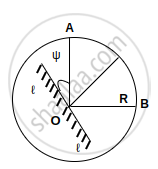
The mirror of length 2l makes 10 revolutions per minute about the axis crossing its mid-point O and perpendicular to the plane of the figure There is a light source in point A and an observer at point B of the circle of radius R drawn around centre O (∠AOB = 90°) What is the proportion `"R"/ℓ` if the observer B first sees the light source when the angle of mirror ψ = 15°?
With the help of a diagram, show how a plane wave is reflected from a surface. Hence, verify the law of reflection.
Which equality relates AE to the distance advanced by the wavefront from B to C?
Once the laws of reflection and refraction are known, the behaviour of which objects can be understood?
Which portion of an incoming wavefront is delayed more by a thin prism, and why?
What feature appears in the emerging wavefront of a plane wave passing through a thin convex lens?
What kind of wave is formed when a plane wave is reflected by a concave mirror?
Where does the spherical wave reflected by a concave mirror converge?
