Advertisements
Advertisements
प्रश्न
Using division of polynomials, state whether
z2 + 3 is a factor of z5 − 9z
बेरीज
Advertisements
उत्तर
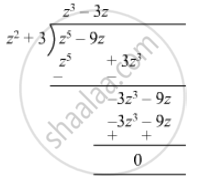
Remainder is zero; therefore, z2 + 3 is a factor of
\[z^5 - 9z\]
shaalaa.com
या प्रश्नात किंवा उत्तरात काही त्रुटी आहे का?
संबंधित प्रश्न
Divide the given polynomial by the given monomial.
(3y8 − 4y6 + 5y4) ÷ y4
Divide 4z3 + 6z2 − z by −\[\frac{1}{2}\]
Divide −21 + 71x − 31x2 − 24x3 by 3 − 8x.
Verify the division algorithm i.e. Dividend = Divisor × Quotient + Remainder, in each of the following. Also, write the quotient and remainder.
| Dividend | Divisor |
| 4y3 + 8y + 8y2 + 7 | 2y2 − y + 1 |
Divide the first polynomial by the second in each of the following. Also, write the quotient and remainder:
3x2 + 4x + 5, x − 2
Divide:
acx2 + (bc + ad)x + bd by (ax + b)
Divide: 15a3b4 − 10a4b3 − 25a3b6 by −5a3b2
Divide: −14x6y3 − 21x4y5 + 7x5y4 by 7x2y2
8x3y ÷ 4x2 = 2xy
Divide: (32y2 – 8yz) by 2y
