Advertisements
Advertisements
प्रश्न
Two particles A and B with charges q and 2q, respectively, are placed on a smooth table with a separation d. A third particle C is to be clamped on the table in such a way that the particles A and B remain at rest on the table under electrical forces. What should be the charge on C and where should it be clamped?
Advertisements
उत्तर
For equilibrium,
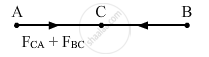
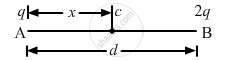
\[\text{Again }, \vec{F}_{AC} = \vec{F}_{CB} \]
\[\text{So} , \frac{1}{x^2} = \frac{2}{\left( d - x \right)^2}\]
\[\text{Or 2 x}^2 = \left( d - x \right)^2 \]
\[ \text{Or }\sqrt{2}x = d - x\]
\[ \text{Or x } = (\sqrt{2} - 1)d\]
For a charge at rest,
\[\vec{F}_{AC} = \vec{F}_{CB} \]
\[\frac{1}{4\pi \in_0}\frac{q\theta}{[(\sqrt{2} - 1)d ]^2} + \frac{1}{4\pi \in_0}\frac{q \times 2q}{d^2}\]
\[ = 0\]
\[ \text{ Or } \theta = (6 - 4\sqrt{2})q\]
