Advertisements
Advertisements
प्रश्न
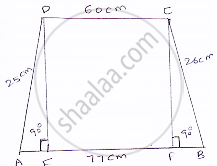
Two parallel side of a trapezium are 60 cm and 77 cm and other sides are 25 cm and 26 cm. Find the area of the trapezium.
Advertisements
उत्तर
Given that two parallel sides of trapezium are AB = 77 and CD = 60 cm
Other sides are BC = 26 m and AD = 25 cm.
Join AE and CF
Now, DE ⊥ AB and CF ⊥ AB
∴ DC = EF = 60 cm
Let AE = x
⇒ BF = 77 – 60 – x = 17 – x
`In ΔADE, DE^2 = AD^2 – AE^2 = 25^2 – x^2` [∵ Pythagoras theorem]
And in ΔBCF, `CF^2= BC^2 – BF^2` [∵ By Pythagoras theorem]
`⇒25=sqrt(26^2-(17-x)^2)`
`⇒25^2-x^2=25^2-(289-x^2-34-x)` [ ∵`(a-b)^2=a^2-2ab+b^2` ]
`⇒265-x^2=676-289-x^2+34x`
`34x=238`
`x=7`
`∴ DE =sqrt(25^2-x^2)=sqrt(625-7^2)=sqrt(516)=24cm`
∴ Area of trapezium = `1/2`(𝑠𝑢𝑚 𝑜𝑓 𝑝𝑎𝑟𝑎𝑙𝑙𝑒𝑙 𝑠𝑖𝑑𝑒𝑠)×ℎ𝑒𝑖𝑔ℎ𝑡=`1/2`(60×77)×24=`1644cm^2`
APPEARS IN
संबंधित प्रश्न
A field is in the shape of a trapezium whose parallel sides are 25 m and 10 m. The non-parallel sides are 14 m and 13 m. Find the area of the field.
Find the area of a rhombus whose perimeter is 80 m and one of whose diagonal is 24 m.
Find the area of a quadrilateral ABCD in which AD = 24 cm, ∠BAD = 90° and BCD forms an equilateral triangle whose each side is equal to 26 cm. (Take √3 = 1.73)
Find the area of an equilateral triangle having each side x cm.
The perimeter of a triangullar field is 144 m and the ratio of the sides is 3 : 4 : 5. Find the area of the field.
Let Δ be the area of a triangle. Find the area of a triangle whose each side is twice the side of the given triangle.
The sides of a triangle are 11 m, 60 m and 61 m. The altitude to the smallest side is
The lengths of the sides of Δ ABC are consecutive integers. It Δ ABC has the same perimeter as an equilateral triangle with a side of length 9 cm, what is the length of the shortest side of ΔABC?
A square and an equilateral triangle have equal perimeters. If the diagonal of the square is \[12\sqrt{2}\] cm, then area of the triangle is
The sides of a triangle are 56 cm, 60 cm and 52 cm long. Then the area of the triangle is ______.
