Advertisements
Advertisements
प्रश्न
- Two insulated charged copper spheres A and B have their centers separated by a distance of 50 cm. What is the mutual force of electrostatic repulsion if the charge on each is 6.5 × 10⁻⁷ C? The radii of A and B are negligible compared to the distance of separation.
- What is the force of repulsion if each sphere is charged double the above amount, and the distance between them is halved?
Advertisements
उत्तर
(a) 
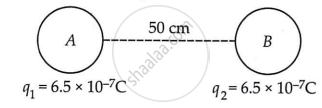
Charge on sphere A, qA = Charge on sphere B, qB = 6.5 × 10⁻⁷ C
Distance between the spheres, r = 50 cm = 0.5 m
Force of repulsion between the two spheres,
`"F" = ("q"_"A""q"_"B")/(4piin_0r^2)`
Where,
∈0 = Free space permittivity
`1/(4piin_0) = 9 xx 10^9 "N m"^2 "C"^-2`
∴ `"F" = (9 xx 10^9 xx (6.5 xx 10^-7)^2)/((0.5)^2)`
= 1.52 × 10⁻² N
Therefore, the force between the two spheres is 1.52 × 10⁻² N.
(b) After doubling the charge, charge on sphere A, qA = Charge on sphere B, qB = 2 × 6.5 × 10−7 C = 1.3 × 10⁻⁶ C
The distance between the spheres is halved.
∴ `"r" = 0.5/2`
= 0.25 m
Force of repulsion between the two spheres,
`F = ("q"_"A" "q"_"B")/(4 pi ∈_0 r^2)`
= `(9 xx 10^9 xx 1.3 xx 10^-6 xx 1.3 xx 10^-6)/(0.25)^2`
= 16 × 1.52 × 10-2
= 0.243 N
Therefore, the force between the two spheres is 0.243 N.
APPEARS IN
संबंधित प्रश्न
Check that the ratio ke2/G memp is dimensionless. Look up a Table of Physical Constants and determine the value of this ratio. What does the ratio signify?
Suppose that the particle is an electron projected with velocity vx = 2.0 × 10⁶ m s−1. If E between the plates separated by 0.5 cm is 9.1 × 10² N/C, where will the electron strike the upper plate? (|e| = 1.6 × 10⁻¹⁹ C, me = 9.1 × 10⁻³¹ kg)
Write any two important points of similarities and differences each between Coulomb's law for the electrostatic field and Biot-Savart's law of the magnetic field ?
At what separation should two equal charges, 1.0 C each, be placed, so that the force between them equals the weight of a 50 kg person?
Two charged particles are placed 1.0 cm apart. What is the minimum possible magnitude of the electric force acting on each charge?
Estimate the number of electrons in 100 g of water. How much is the total negative charge on these electrons?
NaCl molecule is bound due to the electric force between the sodium and the chlorine ions when one electron of sodium is transferred to chlorine. Taking the separation between the ions to be 2.75 × 10⁻⁸ cm, find the force of attraction between them. State the assumptions (if any) that you have made.
Ten positively-charged particles are kept fixed on the x-axis at points x = 10 cm, 20 cm, 30 cm, ...., 100 cm. the first particle has a charge 1.0 × 10⁻⁸ C, the second 8 × 10⁻⁸ C, the third 27 × 10−8 C and so on. The tenth particle has a charge 1000 × 10−8 C. Find the magnitude of the electric force acting on a 1 C charge placed at the origin.
Two particles A and B, each carrying a charge Q, are held fixed with a separation dbetween them. A particle C of mass m and charge q is kept at the middle point of the line AB. Under what conditions will the particle C execute simple harmonic motion if it is released after such a small displacement? Find the time period of the oscillations if these conditions are satisfied.
Two particles A and B possessing charges of +2.00 × 10⁻⁶ C and of −4.00 × 10⁻⁶ C, respectively, are held fixed at a separation of 20.0 cm. Locate the points (s) on the line AB, where (a) the electric field is zero (b) the electric potential is zero.
Define a unit charge.
Two-point charges of + 0.2 µµC and -0.2 µµC are separated by 1 o8 m. What is the value of the electric field at an axial point at a distance of 0.1 m from their mid-point?
Two positive charges ______.
SI unit of permittivity of free space is ______.
Two charge – 10c and + 10 c are placed 10 cm apart. Potential at centre of the line joining the two charge is:-
Identify the wrong statement in the following.
Coulomb's law correctly describes the electric force that ______.
Electric charge of any system is ______.
Two charges q and – 3q are placed fixed on x-axis separated by distance ‘d’. Where should a third charge 2q be placed such that it will not experience any force?
According to Coulomb's law, which is the correct relation for the following figure?

