मराठी
कर्नाटक बोर्ड पी.यू.सी.पीयूसी विज्ञान इयत्ता ११

Two Identical Pith Balls Are Charged by Rubbing One Against Other.They Are Suspended from a Horizontal Rod Through Two Strings of Length 20 Cm Each, Separation Between the Suspension Points Being 5 Cm - Physics

Advertisements
Advertisements

प्रश्न

Two identical pith balls are charged by rubbing one against the other. They are suspended from a horizontal rod through two strings of length 20 cm each, the separation between the suspension points being 5 cm. In equilibrium, the separation between the balls is 3 cm. Find the mass of each ball and the tension in the strings. The charge on each ball has a magnitude 2.0 × 10⁻⁸ C.

टीपा लिहा
Advertisements

उत्तर
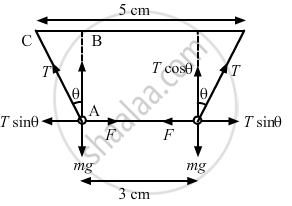
 

As given, q = 2 × 10⁻⁸ and r = 3 cm = 3 × 10⁻²m

Force between two charged particles

∵ `F = (kq_1q_2)/r^2`

= `(9 xx 10^9 xx 2 xx 10^-8 xx 2 xx 10^-8)/((3 xx 10^-2)^2)`

= 4 × 10⁻³H
from Fig T sin θ = F   ...(i)

T cos θ = mg   ...(ii)

Tan θ = `F/(mg)`

Here, Tan θ = `P/B = 1/sqrt399 ≈ 1/20`

and `1/20 = F/(mg)`

m = `(20F)/g`

m = 8 g

T = `F/sin θ`

= `(4 xx 10^-3)/(1/20)`

= 8 × 10⁻² N

shaalaa.com
  या प्रश्नात किंवा उत्तरात काही त्रुटी आहे का?
पाठ 7: Electric Field and Potential - Exercises [पृष्ठ १२१]

APPEARS IN

एचसी वर्मा Concepts of Physics Vol. 2 [English] Class 11 and 12
पाठ 7 Electric Field and Potential
Exercises | Q 23 | पृष्ठ १२१

संबंधित प्रश्‍न

Check that the ratio ke2/G memp is dimensionless. Look up a Table of Physical Constants and determine the value of this ratio. What does the ratio signify?


  1. Two insulated charged copper spheres A and B have their centers separated by a distance of 50 cm. What is the mutual force of electrostatic repulsion if the charge on each is 6.5 × 10⁻⁷ C? The radii of A and B are negligible compared to the distance of separation.
  2. What is the force of repulsion if each sphere is charged double the above amount, and the distance between them is halved?

Three-point charges q, – 4q and 2q are placed at the vertices of an equilateral triangle ABC of side 'l' as shown in the figure. Obtain the expression for the magnitude of the resultant electric force acting on the charge q

(b) Find out the amount of the work done to separate the charges at infinite distance.


Does the force on a charge due to another charge depend on the charges present nearby?


Find the dimensional formula of ε0.


At what separation should two equal charges, 1.0 C each, be placed, so that the force between them equals the weight of a 50 kg person? 


Two charges 2.0 × 10⁻⁶ C and 1.0 × 10⁻⁶ C are placed at a separation of 10 cm. Where should a third charge be placed, such that it experiences no net force due to these charges?


Suppose the second charge in the previous problem is −1.0 × 10⁶ C. Locate the position where a third charge will not experience a net force. 


NaCl molecule is bound due to the electric force between the sodium and the chlorine ions when one electron of sodium is transferred to chlorine. Taking the separation between the ions to be 2.75 × 10⁻⁸ cm, find the force of attraction between them. State the assumptions (if any) that you have made. 


Repeat the previous problem if the particle C is displaced through a distance x along the line AB. 


Two particles A and B possessing charges of +2.00 × 10⁻⁶ C and of −4.00 × 10⁻⁶ C, respectively, are held fixed at a separation of 20.0 cm. Locate the points (s) on the line AB, where (a) the electric field is zero (b) the electric potential is zero.  


A water particle of mass 10.0 mg and with a charge of 1.50 × 10⁻⁶ C stays suspended in a room. What is the magnitude of electric field in the room? What is its direction ? 


Define a unit charge.


A force F acts between sodium and chlorine ions of salt (sodium chloride) when put 1 cm apart in air. The permittivity of air and dielectric constant of water are `epsilon_0` and K respectively. When a piece of salt is put in water, electrical force acting between sodium and chlorine ions 1 cm apart is ____________.


Two positive charges ______.


The unit of charge is ______.


Two charges of equal magnitudes kept at a distance r exert a force F on each other. If the charges are halved and distance between them is doubled, then the new force acting on each charge is ______.


Two charge – 10c and + 10 c are placed 10 cm apart. Potential at centre of the line joining the two charge is:-


Four charges equal to −Q are placed at the four a corners of a square and charge q is at its centre. If the system is in equilibrium, the value of q is ______.


Share
Notifications

Englishहिंदीमराठी


      Forgot password?
Use app×