Advertisements
Advertisements
प्रश्न
Two bulbs are rated: bulb A 100W, 120 V bulb B 10W, 120 V. If both are connected across a 120V supply, which bulb will consume more energy, When in series? Also calculate the current through each bulb in above cases.
Advertisements
उत्तर
In the case of bulb A, Power: P = `"V"^2/"R"_"A"`
RA = `"V"^2/"P" = (120 xx 120)/100` = 144 Ω
i.e., Resistance (RA) of bulb, A = 144 Ω
Similarly resistance RB of bulb, B = `"V"^2/"P"`
`= (120 xx 120)/10 = 1440` Ω
When the bulb are connected in series:
R = RA + RB = 144 + 1440 = 1584 Ω
∴ Current in the circuit `= "V"/"R" = 120/1584 = 0.076` A
Being in series, the same current passes through both the bulbs.
Power consumed in bulbs A = PA = i2 RA = (0.076)2 × 144 = 0.8317 W
Power consumed in bulbs B = PB = i2 RB = (0.076)2 × 144 = 8.317 W
This clearly shows that PA < PB i.e., bulb B (10W, 120 V) consumes more energy when these are connected series.
संबंधित प्रश्न
Which quantity has the unit of watt?
State whether an electric heater will consume more electrical energy or less electrical energy per second when the length of its heating element is reduced. Give reasons for your answer.
Name two gases which are filled in filament type electric light bulbs.
Name the physical quality which is measured in
(i) Kw (ii) kWh
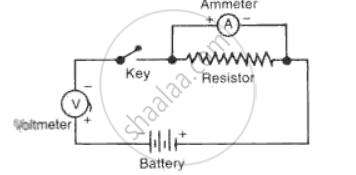
What is wrong with the circuit diagram (Fig. 34)? Carefully check the symbols and assign proper positive and negative signs to them.
What is the energy conversion when an electric current passes through a metallic wire?
Point out two main disadvantages of ‘Tree System’.
Name two common material used for heating elements.
The following table gives the electrical appliances used, their power and the average time for which they are used each day in a home. Estimate the monthly electricity bill if the rate is 60 paise per unit.
| Sr.no. | Name | Nos. | Power rating | Time/day |
| 1 | Bulb | 4 | 100 W | 7.5 hr |
| 2 | Fans | 2 | 50 W | 10 hr |
| 3 | T.V. | 1 | 100 W | 2 hr |
| 4 | Iron | 1 | 500 W | 1 hr |
| 5 | Electric stove | 1 | 750 W | 2 hr |
A conductor of 10 Ω is connected across a 6 V ideal source. The power supplied by the source to the conductor is ______.
