Advertisements
Advertisements
प्रश्न
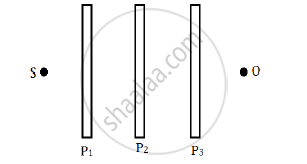
Three identical polaroid sheets P1, P2 and P3 are oriented so that the pass axis of P2 and P3 are inclined at angles of 60° and 90° respectively with the pass axis of P1. A monochromatic source S of unpolarised light of intensity I0 is kept in front of the polaroid sheet P1 as shown in the figure. Determine the intensities of light as observed by the observer at O, when polaroid P3 is rotated with respect to P2 at angles θ = 30° and 60°.
Advertisements
उत्तर
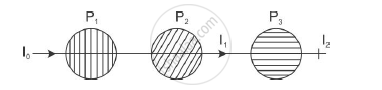
The ray of light passing through polaroid P1 will have intensity reduced by half.'
`I_1=I_0/2`
Now, the polaroid P2 is oriented at an angle 60° with respect to P1.
Therefore, the intensity is
`I_2=I_1cos^2 60=I_0/2xx1/4=I_0/8`
Now, the polaroid P3 is originally oriented at an angle 90 − 60 = 30°. Hence, when P3 is rotated by 30°, the angle between P2 and P3 is 60°. Therefore, the intensity is
`I_3=I_2cos^2 60=I_0/8cos^2 60=I_0/8xx1/4=I+0/32`
Similarly, when P3 is rotated by 60°, the angle between P2 and P3 is 90°.
Therefore, the intensity is `I_3=I_2cos^2 90=I_0/8xx0xx0`
APPEARS IN
संबंधित प्रश्न
How does one demonstrate, using a suitable diagram, that unpolarised light when passed through a Polaroid gets polarised?
Two polaroids P1 and P2 are placed with their pass axes perpendicular to each other. An unpolarised light of intensity Io is incident on P1. A third polaroid P3 is kept in between P1 and P2 such that its pass axis makes an angle of 45° with that of P1. Determine the intensity of light transmitted through P1, P2 and P3
Two polaroids P1 and P2 are placed with their pass axes perpendicular to each other. Unpolarised light of intensity I0 is incident on P1. A third polaroid P3 is kept in between P1 and P2 such that its pass axis makes an angle of 60° with that of P1. Determine the intensity of light transmitted through P1, P2 and P3.
A ray of light passes from a vacuum to a medium of refractive index (μ). The angle of
incidence is found to be twice the angle of refraction. The angle of incidence is _______.
A) `cos^(-1)(mu/2)`
B) cos−1(μ)
C) `2 cos^(-1) (mu/2)`
D) `2 sin^(-1) (mu/2)`
The glass plate of refractive index 1.732 is to be used as a polarizer, its polarising angle is _______.
The transverse nature of light is shown in ______.
An unpolarised light of intensity 32 Wm-2 passes through three Polaroids such that the axes of the first and the last Polaroids are at 90°. What is the angle between the axes of the first and middle Polaroids so that the emerging light has an intensity of only 3 Wm-2?
The reflected light is found to be plane polarised when an unpolarized light falls on a denser medium at 60° with the normal. Find the angle of refraction and critical angle of incidence for total internal reflection in the denser to rarer medium reflection.
A plane mirror produces a magnification of
To ensure almost 100 per cent transmissivity, photographic lenses are often coated with a thin layer of dielectric material. The refractive index of this material is intermediated between that of air and glass (which makes the optical element of the lens). A typically used dielectric film is MgF2 (n = 1.38). What should the thickness of the film be so that at the center of the visible spectrum (5500 Å) there is maximum transmission.
