Advertisements
Advertisements
प्रश्न
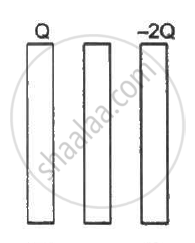
Three identical metal plates with large surface areas are kept parallel to each other as shown in the following figure. The leftmost plate is given a charge Q, the rightmost a charge −2Q and the middle one is kept neutral. Find the charge appearing on the outer surface of the rightmost plate.
Advertisements
उत्तर
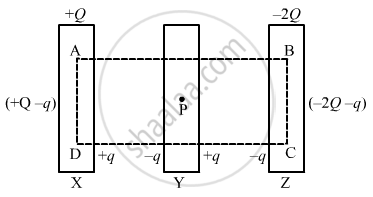
Consider the Gaussian surface as shown in the figure.
Let the charge on the outer surface of the left-most plate be q. Thus, the charges on the plates are distributed as shown in the following diagram.
The net field at point P due to all the induced charges must be zero, as it is lying inside the metal surface.
Let the surface area of the plates be A.
Electric field at point P due to the charges on plate X:-
Due to charge (+ Q -q) is `("Q" -"q")/(2"A"∈_0)` in the right direction
Due to charge (+q) is `"q"/(2"A"∈_0)` in the right direction
Electric field at point P due to charges on plate Y:-
Due to charge (-q) is `"q"/(2"A"∈_0)` in the right direction
Due to charge (+q) is `"q"/(2"A"∈_0)` in the left direction.
Electric field at point P due to charges on plate Z:-
Due to charge (-q) is `"q"/(2"A"∈_0)` in the right direction.
Due to charge (-2Q+q) is `(2"Q"-"q")/(2"A"∈_0)` in the right direction
The net electric field at point P:-
`("Q"-"q")/(2"A"∈_0)+"q"/(2"A"∈_0) -"q"/(2"A"∈_0) - "q"/(2"A"∈_0) + "q"/(2"A"∈_0) + (2"Q"-"q")/(2"A"∈_0) = 0`
`("Q"-"q")/(2"A"∈_0) + (2"Q" -"q")/(2"A"∈_0) = 0`
`Q - q + 2Q - q = 0`
`3Q - q = 0`
`"q" =(3"Q")/2`
Thus, the charge on the outer plate of the right-most plate = `-2"Q" +"q" = -2"Q"+ (3"Q")/2 = -"Q"/2`
