Advertisements
Advertisements
प्रश्न
Three fair coins are tossed simultaneously. Find the probability mass function for a number of heads that occurred
Advertisements
उत्तर
When three coins are tossed, the sample space is
S = {HHH, HHT, HTH, HTT, THH, THT, TTH, TTT}
‘X’ is the random variable that denotes the number of heads.
∴ ‘X’ can take the values of 0, 1, 2 and 3
Sample space S = {HHH, HHT, HTH, THH, HTT, THT, TTH, TTT}
| Values of random variable | 0 | 1 | 2 | 3 | Total |
| Number of elements in inverse image | 1 | 3 | 3 | 1 | 8 |
Probability mass function
| x | 0 | 1 | 2 | 3 |
| f(x) = P(X = x) | `1/8` | `3/8` | `3/8` | `1/8` |
or
f(x) = `{{:(1/8, "for" x = 0",", 3),(3/8, "for" x = 1",", 2):}`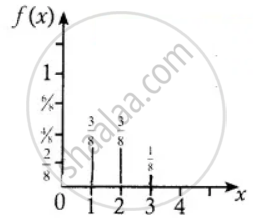
APPEARS IN
संबंधित प्रश्न
Suppose error involved in making a certain measurement is continuous r.v. X with p.d.f.
f (x) = k `(4 – x^2 )`, for –2 ≤ x ≤ 2 and = 0 otherwise.
P(x > 0)
Suppose error involved in making a certain measurement is continuous r.v. X with p.d.f.
f (x) = k `(4 – x^2)`, for –2 ≤ x ≤ 2 and = 0 otherwise.
P (–0·5 < x or x > 0·5)
Given the p.d.f. of a continuous r.v. X ,
f (x) = `x^2 /3` , for –1 < x < 2 and = 0 otherwise
Determine c.d.f. of X hence find P( x < –2)
Given the p.d.f. of a continuous r.v. X ,
f (x) = `x^2/3` , for –1 < x < 2 and = 0 otherwise
Determine c.d.f. of X hence find P(1 < x < 2)
In the p.m.f. of r.v. X
| X | 1 | 2 | 3 | 4 | 5 |
| P (X) | `1/20` | `3/20` | a | 2a | `1/20` |
Find a and obtain c.d.f. of X.
Solve the following problem :
A player tosses two coins. He wins ₹ 10 if 2 heads appear, ₹ 5 if 1 head appears, and ₹ 2 if no head appears. Find the expected value and variance of winning amount.
It is felt that error in measurement of reaction temperature (in celsius) in an experiment is a continuous r.v. with p.d.f.
f(x) = `{(x^3/(64), "for" 0 ≤ x ≤ 4),(0, "otherwise."):}`
Verify whether f(x) is a p.d.f.
Fill in the blank :
The values of discrete r.v. are generally obtained by _______
Fill in the blank :
The value of continuous r.v. are generally obtained by _______
Solve the following problem :
Identify the random variable as discrete or continuous in each of the following. Identify its range if it is discrete.
An economist is interested in knowing the number of unemployed graduates in the town with a population of 1 lakh.
Solve the following problem :
Identify the random variable as discrete or continuous in each of the following. Identify its range if it is discrete.
Twelve of 20 white rats available for an experiment are male. A scientist randomly selects 5 rats and counts the number of female rats among them.
Solve the following problem :
Identify the random variable as discrete or continuous in each of the following. Identify its range if it is discrete.
A highway safety group is interested in the speed (km/hrs) of a car at a check point.
c.d.f. of a discrete random variable X is
A coin is tossed 10 times. The probability of getting exactly six heads is ______.
Out of 100 people selected at random, 10 have common cold. If five persons selected at random from the group, then the probability that at most one person will have common cold is ______.
A six sided die is marked ‘1’ on one face, ‘3’ on two of its faces, and ‘5’ on remaining three faces. The die is thrown twice. If X denotes the total score in two throws, find the cumulative distribution function
Find the probability mass function and cumulative distribution function of a number of girl children in families with 4 children, assuming equal probabilities for boys and girls
Suppose a discrete random variable can only take the values 0, 1, and 2. The probability mass function is defined by
`f(x) = {{:((x^2 + 1)/k"," "for" x = 0"," 1"," 2),(0"," "otherwise"):}`
Find cumulative distribution function
The cumulative distribution function of a discrete random variable is given by
F(x) = `{{:(0, - oo < x < - 1),(0.15, - 1 ≤ x < 0),(0.35, 0 ≤ x < 1),(0.60, 1 ≤ x < 2),(0.85, 2 ≤ x < 3),(1, 3 ≤ x < oo):}`
Find the probability mass function
The cumulative distribution function of a discrete random variable is given by
F(x) = `{{:(0, - oo < x < - 1),(0.15, - 1 ≤ x < 0),(0.35, 0 ≤ x < 1),(0.60, 1 ≤ x < 2),(0.85, 2 ≤ x < 3),(1, 3 ≤ x < oo):}`
Find P(X < 1)
A random variable X has the following probability mass function.
| x | 1 | 2 | 3 | 4 | 5 |
| F(x) | k2 | 2k2 | 3k2 | 2k | 3k |
Find P(2 ≤ X < 5)
The cumulative distribution function of a discrete random variable is given by
F(x) = `{{:(0, "for" - oo < x < 0),(1/2, "for" 0 ≤ x < 1),(3/5, "for" 1 ≤ x < 2),(4/5, "for" 2 ≤ x < 4),(9/5, "for" 3 ≤ x < 4),(1, "for" ≤ x < oo):}`
Find the probability mass function
If Xis a.r.v. with c.d.f F (x) and its probability distribution is given by
| X = x | - 1.5 | -0.5 | 0.5 | 1.5 | 2.5 |
| P(X = x) | 0.05 | 0.2 | 0.15 | 0.25 | 0.35 |
then, F(1.5) - F(- 0.5) = ?
Choose the correct alternative:
A pair of dice numbered 1, 2, 3, 4, 5, 6 of a six-sided die and 1, 2, 3, 4 of a four-sided die is rolled and the sum is determined. Let the random variable X denote this sum. Then the number of elements in the inverse image of 7 is
Choose the correct alternative:
Which of the following is a discrete random variable?
I. The number of cars crossing a particular signal in a day.
II. The number of customers in a queue to buy train tickets at a moment.
III. The time taken to complete a telephone call.
A bag contains 6 white and 4 black balls. Two balls are drawn at random. The probability that they are of the same colour is ______.
If the c.d.f (cumulative distribution function) is given by F(x) = `(x - 25)/10`, then P(27 ≤ x ≤ 33) = ______.
If A = {x ∈ R : x2 - 5 |x| + 6 = 0}, then n(A) = _____.
If the probability function of a random variable X is defined by P(X = k) = a`((k + 1)/2^k)` for k - 0, 1, 2, 3, 4, 5, then the probability that X takes a prime value is ______
Two coins are tossed. Then the probability distribution of number of tails is.
Find the probability of getting the sum as a perfect square number when two dice are thrown together.
