Advertisements
Advertisements
प्रश्न
Thinking about the Poem
What should we do to make friends with the wind?
Advertisements
उत्तर
To make friends with wind we need to build strong homes with firm doors. We should also make ourselves physically and mentally strong by building strong, firm bodies and having steadfast hearts.
संबंधित प्रश्न
Read the song once again.
I am dotted silver threads dropped from heaven
By the gods. Nature then takes me, to adorn
Her fields and valleys.
I am beautiful pearls, plucked from the
Crown of Ishtar by the daughter of Dawn
To embellish the gardens.
When I cry the hills laugh;
When I humble myself the flowers rejoice;
When I bow, all things are elated.
The field and the cloud are lovers
And between them I am a messenger of mercy.
I quench the thirst of the one;
I cure the ailment of the other.
The voice of thunder declares my arrival;
The rainbow announces my departure.
I am like earthly life which begins at
The feet of the mad elements and ends
Under the upraised wings of death.
I emerge from the heart of the sea and
Soar with the breeze. When I see a field in
Need, I descend and embrace the flowers and
The trees in a million little ways.
I touch gently at the windows with my
Soft fingers, and my announcement is a
Welcome song. All can hear, but only
The sensitive can understand.
I am the sigh of the sea;
The laughter of the field;
The tears of heaven.
So with love -
Sighs from the deep sea of affection; Laughter from the colourful
field of the spirit; Tears from the endless heaven of memories.
About the Poet
Kahlil Gibran (1883-1931) was a Lebanese-American artist, poet and writer. His
poetry is notable for its use of formal language as well as insights on topics of life using
spiritual terms. One of his most notable lines of poetry in the English-speaking world is
from Sand and Foam (1926) which reads 'Half of what I say is meaningless, but I say
it so that the other half may reach you.'
Read the comic strip based on. H.G. Wells' novells.


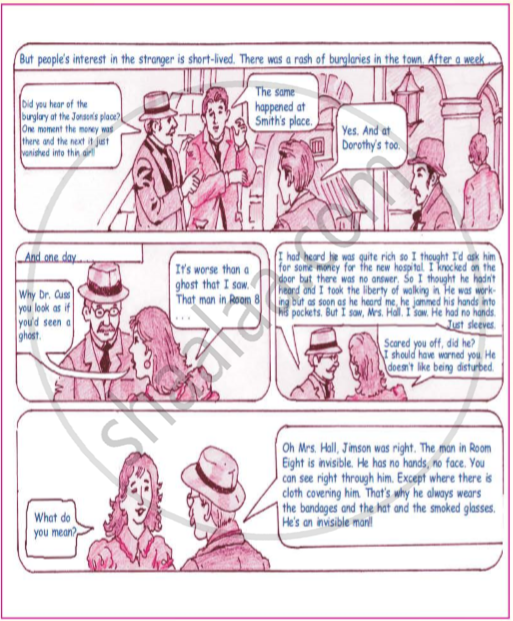
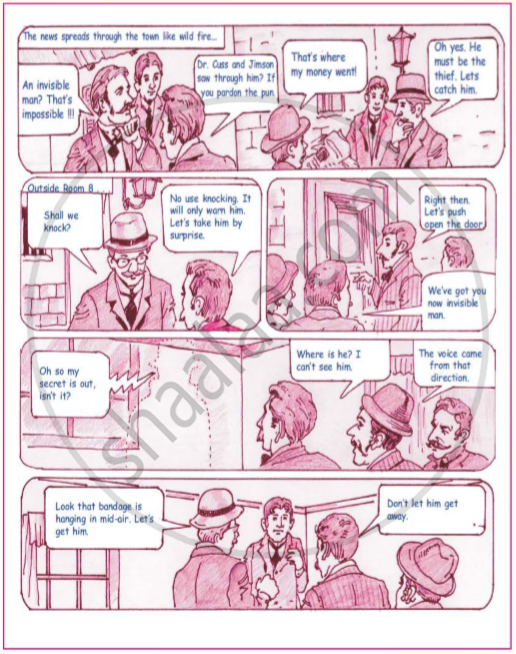
Answer the questions by ticking the correct option.
(a) The strange-looking man wanted ....
(i) the best room at the inn.
(ii} a room with a fire and a good lock.
(iii} a room with a good view.
(iv) a room where he could work quietly.
(b) Jimson was suspicious of the stranger because ...
(i} he did not answer Jimson's questions.
(ii} he did not want to talk about the weather.
(iii} he kept his back turned towards Jimson at all times.
(iv) he shouted atJimson when he entered his room.
(c) The people of the town gossiped about the stranger as ...
(i} he did not go out or talk to anyone in the town.
(ii} he had met with an accident and his face was bandaged.
(iii} he was new to the town and behaved rudely.
(iv) he stayed in his room and did not show his face to anyone.
(d) 'There was a rush of burglaries in the town. This means that ________
(i} there were many robberies in the town.
(ii) a few people in the town had seen a rob her.
(iii} the burglaries in the town were done in a rush.
(iv) the burglar was a rash and careless man.
(e) Although Jimson and Dr Cuss are suspicious of the strange guest, Mrs Hall tolerates him because ....
(i} she is not superstitious or ignorant.
(ii) she is sorry for the stranger who is bandaged.
(iii} the stranger is paying her a good amount of money for the room.
(iv} the stranger is polite and kind to Mrs Hall at all times.
(f) The stranger who was staying at the inn can be described as being ....
(I} violent
(ii} upright
(iii} dishonest
(iv) sensible
Old Kaspar took it from the boy,
Who stood expectant by;
And then the old man shook his head,
And,with a natural sigh,
"Tis some poor fellow's skull," said he,
"Who fell in the great victory.
"I find them in the garden,
For there's many here about;
And often when I go to plough,
The ploughshare turns them out!
For many thousand men,"said he,
"Were slain in that great victory."
Read the lines given above and answer the question that follow.
What did Old Kasper do when Peterkin came to him with the object?
Such wondrous, fine, fantastic tales
Of dragons, gypsies, queens, and whales
And treasure isles, and distant shores
Where smugglers rowed with muffled oars,
And pirates wearing purple pants,
And sailing ships and elephants,
And cannibals crouching 'round the pot,
Stirring away at something hot.
(It smells so good , what can it be?
Good gracious, it's Penelope.)
The younger ones had Beatrix Potter
With Mr.Tod,the dirty rotter,
And Squirrel Nutkin,Pigling Bland,
And Mrs.Tiggy-Winkle and-
Just How The Camel Got His Hump,
And How the Monkey Lost His Rump,
And Mr. Toad, and bless my soul,
There's Mr.Rat and Mr. Mole-
Oh, books, what books they used to know,
Those children living long ago!
Read the lines given above and answer the question given below.
Why does Dahl call television an idiot box?
After considering the matter, and talking it over with his wife, farmer Jones said that he would take John, and do well by him, now that his mother was out of the way; and Mrs. Ellis, who had been looking out for a bound girl, concluded that it would be charitable in her to make choice of Katy, even though she was too young to be of much use for several years.
“I could do much better, I know,” said Mrs. Ellis; “but as no one seems inclined to take her, I must act from a sense of duty expect to have trouble with the child; for she’s an undisciplined thing—used to having her own way.”
But no one said “I’ll take Maggie.” Pitying glances were cast on her wan and wasted form and thoughts were troubled on her account. Mothers brought cast-off garments and, removing her soiled and ragged clothes, dressed her in clean attire. The sad eyes and patient face of the little one touched many hearts, and even knocked at them for entrance. But none opened to take her in. Who wanted a bed-ridden child?
“Take her to the poorhouse,” said a rough man, of whom the question “What’s to be done with Maggie?” was asked. “Nobody’s going to be bothered with her.”
“The poorhouse is a sad place for a sick and helpless child,” answered one.
“For your child or mine,” said the other, lightly speaking; “but for tis brat it will prove a blessed change, she will be kept clean, have healthy food, and be doctored, which is more than can be said of her past condition.”
Read the extract given below and answer the question that follow.
Who came to mourn the dead woman? Why did no one follow the dead cart?
Then, trying to hide my nervousness, I added, “How are you?”
“I’m fine. The question is: How are you?“
“What do you mean?” 1 asked “Something must be eating you,” he said—proud the way foreigners are when they’ve mastered a bit of American slang. “You should be able to qualify with your eyes closed.”
“Believe me, I know it,” I told him—and it felt good to say that to someone.
For the next few minutes we talked together. I didn’t tell Long what was “eating” me, but he seemed to understand my anger, and he took pains to reassure me. Although he’d been schooled in the Nazi youth movement, he didn’t believe in the Aryan-supremacy business any more than I did. We laughed over the fact that he really looked the part, though. An inch taller than I, he had a lean, muscular frame, clear blue eyes, blond hair and a strikingly handsome, chiseled face. Finally, seeing that I had calmed down somewhat, he pointed to the take-off board.
“Look,” he said. “Why don’t you draw a line a few inches in back of the board and aim at making your take-off from there? You’ll be sure not to foul, and you certainly ought to jump far enough to qualify. What does it matter if you’re not first in the trials? Tomorrow is what counts.”
Read the extract given below and answer the question that follow.
Why did Jesse Owens foul the first two jumps in the trial?
Read the extract given below and answer the questions that follow :
The breaking down of discipline likewise affected the dogs in their relations with one another. They quarreled and bickered more than ever among themselves, till at times the camp was a howling bedlam: 'Dave and Sol-leks alone were unaltered, though they were made irritable by the unending squabbling.
(i) What led to the break-down of discipline in the dog team?
How did it affect the relationship in the dogs?
(ii) What other acts of indiscipline did Buck's encouragement lead to?
(iii) What started the dogs off on a chase after supper one night at the mouth of the river Tahkeena?
(iv) Who led the dogs in the chase? What primitive urge did Buck experience during the chase?
(v) How did Spitz use the chase to try and outwit Buck? What does this reveal of Spitz's nature?
Answer the following question.
“We have orders to let them shout”.What is the policeman referring to?
We should not mess up with things that belong to others. Elaborate.
How did the other bird greet the king?
Why did Vijay Singh ask the ghost disguised as Natwar to come closer?
Why are snakes dangerous, according to you?
Make noun from the word given below by adding –ness, ity, ty or y
Active ___________.
Answer the following question:
How did she become an astronaut? What gave her the idea that she could be an astronaut?
Answer the following question:
What does Kalpana Chawla say about pursuing a dream? Do you agree with her that success is possible?
Describe the appearance of Miss Beam.
What did the speaker do while hiding himself in the banyan tree branches?
What does the child think about his/her teacher?
Answer the following question:
In what way did the shopkeeper make a fool of Rasheed?
How does the poem, Crossing the Bar, portray the poet's deep affirmation and faith in God?
