Advertisements
Advertisements
प्रश्न
The side BC of ΔABC is produced to a point D. The bisector of ∠A meets side BC in L. If ∠ABC = 30° and ∠ACD = 115°, then ∠ALC = ______.
पर्याय
85°
- \[72\frac{1}{2}^\circ\]
145°
none of these
Advertisements
उत्तर
The side BC of ΔABC is produced to a point D. The bisector of ∠A meets side BC in L. If ∠ABC = 30° and ∠ACD = 115°, then ∠ALC = `bbunderline(72 1/2)` °
Explanation:
In the given problem, BC of ΔABC is produced to point D. bisectors of ∠A meet side BC at L, ∠ABC = 30° and ∠ACD = 115°
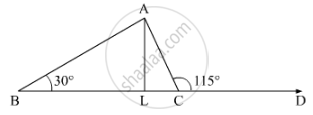
Here, using the property, “exterior angle of a triangle is equal to the sum of the two opposite interior angles”, we get,
In ΔABC
∠ACD = ∠CAB + ∠CBA
115° = ∠CAB + 30°
∠CAB = 115° - 30°
∠CAB = 85°
Now, as AL is the bisector of ∠A
∠CAL = 1/2 ∠CAB
∠CAL = 1/2 (85°)
`∠CAL = 44 (1^\circ)/2`
Also, ∠ACD is the exterior angle of ΔALC
Thus,
Again, using the property, “exterior angle of a triangle is equal to the sum of the two opposite interior angles”, we get,
In ΔALC
∠ACD = ∠CAL + ∠ALC
`115= 44 (1^\circ)/2+∠ALC`
`∠ALC =115- 44 1^\circ/2`
`∠ALC = 72 (1^\circ)/2`
Thus, `∠ALC = 72 1^\circ/2 `
APPEARS IN
संबंधित प्रश्न
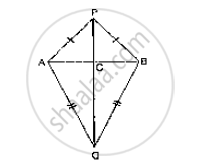
AB is a line seg P and Q are points on opposite sides of AB such that each of them is equidistant from the points A and B (See Fig. 10.26). Show that the line PQ is perpendicular bisector of AB.
The vertical angle of an isosceles triangle is 100°. Find its base angles.
Two lines AB and CD intersect at O such that BC is equal and parallel to AD. Prove that the lines AB and CD bisect at O.
BD and CE are bisectors of ∠B and ∠C of an isosceles ΔABC with AB = AC. Prove that BD = CE.
ABC is a triangle in which BE and CF are, respectively, the perpendiculars to the sides AC and AB. If BE = CF, prove that ΔABC is isosceles
Fill the blank in the following so that the following statement is true.
If altitudes CE and BF of a triangle ABC are equal, then AB = ....
Is it possible to draw a triangle with sides of length 2 cm, 3 cm and 7 cm?
Which of the following statements are true (T) and which are false (F)?
Sum of any two sides of a triangle is greater than the third side.
In the given figure, the sides BC, CA and AB of a Δ ABC have been produced to D, E and F respectively. If ∠ACD = 105° and ∠EAF = 45°, find all the angles of the Δ ABC.
Write the sum of the angles of an obtuse triangle.
If the angles of a triangle are in the ratio 2 : 1 : 3, then find the measure of smallest angle.
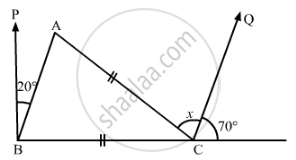
In the given figure, if BP || CQ and AC = BC, then the measure of x is
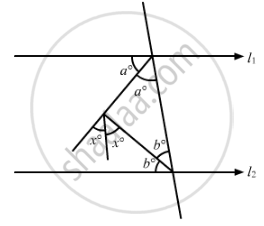
In the given figure, if l1 || l2, the value of x is
In ∆ABC, BC = AB and ∠B = 80°. Then ∠A is equal to ______.
Is it possible to construct a triangle with lengths of its sides as 8 cm, 7 cm and 4 cm? Give reason for your answer.
In the following figure, D and E are points on side BC of a ∆ABC such that BD = CE and AD = AE. Show that ∆ABD ≅ ∆ACE.

CDE is an equilateral triangle formed on a side CD of a square ABCD (Figure). Show that ∆ADE ≅ ∆BCE.

Find all the angles of an equilateral triangle.
In a triangle ABC, D is the mid-point of side AC such that BD = `1/2` AC. Show that ∠ABC is a right angle.
