Advertisements
Advertisements
प्रश्न
The second class railway fare for 240 km of Journey is Rs 15.00. What would be the fare for a journey of 139.2 km?
Advertisements
उत्तर
Let Rs x be the fare for a journey of 139.2 km.
| Distance (in km) | 240 | 139.2 |
| Fare (in Rs.) | 15 | x |
\[\text{ Since the distance travelled and the fare are in direct variation, we have: } \]
\[\frac{240}{139 . 2} = \frac{15}{x}\]
\[ \Rightarrow 240 \times x = 15 \times 139 . 2\]
\[ \Rightarrow x = \frac{15 \times 139 . 2}{240}\]
\[ = \frac{2088}{240}\]
\[ = 8 . 7\]
\[\text{ Thus, the fare for a journey of 139 . 2 km will be Rs } 8 . 70 .\]
संबंधित प्रश्न
A loaded truck travels 14 km in 25 minutes. If the speed remains the same, how far can it travel in 5 hours?
Complite the following table given that x varies directly as y .
| x | 3 | 5 | 7 | 9 |
| y | ... | 20 | 28 | ... |
A and B can do a piece of work in 18 days; B and C in 24 days and A and C in 36 days. In what time can they do it, all working together?
A and B can finish a work in 20 days. A alone can do \[\frac{1}{5}\] th of the work in 12 days. In how many days can B alone do it?
A truck requires 108 liters of diesel for covering a distance of 594 km. How much diesel will be required to cover a distance of 1650 km?
If x = 5y, then x and y vary ______ with each other.
Write whether the following statement vary directly, vary inversely with each other, or neither of the two.
Distance travelled by an auto-rickshaw and time taken.
Write whether the following statement vary directly, vary inversely with each other, or neither of the two.
The number of people working and the quantity of work.
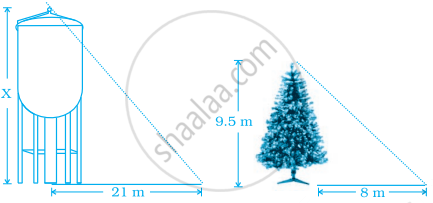
A water tank casts a shadow 21 m long. A tree of height 9.5 m casts a shadow 8 m long at the same time. The lengths of the shadows are directly proportional to their heights. Find the height of the tank.
Kusum always forgets how to convert miles to kilometres and back again. However she remembers that her car’s speedometer shows both miles and kilometres. She knows that travelling 50 miles per hour is same as travelling 80 kilometres per hour. To cover a distance of 200 km, how many miles Kusum would have to go?
