Advertisements
Advertisements
प्रश्न
From the following table, determine if x and y are in direct proportion or not.
| x | 3 | 6 | 15 | 20 | 30 |
| y | 12 | 24 | 45 | 60 | 120 |
Advertisements
उत्तर
In direct proportion, `x/y = k` ...(Constant)
For table
| x | 3 | 6 | 15 | 20 | 30 |
| y | 12 | 24 | 45 | 60 | 120 |
⇒ `x/y = 3/12, 6/24, 15/45, 20/60, 30/120`
i.e. `1/4, 1/4, 1/3, 1/3, 1/4`
So, is not in direct proportion.
APPEARS IN
संबंधित प्रश्न
Fill in the blank in of the following so as to make the statement true:
If u = 3 v, then u and v vary .... with each other.
If the cost of 93 m of a certain kind of plastic sheet is Rs 1395, then what would it cost to buy 105 m of such plastic sheet?
The amount of extension in an elastic spring varies directly with the weight hung on it. If a weight of 250 gm produces an extension of 3.5 cm, find the extension produced by the weight of 700 gm.
If 25 men earn Rs 1000 in 10 days, how much will 15 men earn in 15 days?
For 9 cows, 13 kg 500 g of food supplements are required every day. In the same proportion, how much will be needed for 12 cows?
Meenakshee cycles to her school at an average speed of 12 km/h and takes 20 minutes to reach her school. If she wants to reach her school in 12 minutes, her average speed should be ______.
On increasing a, b increases in such a manner that `a/b` remains ______ and positive, then a and b are said to vary directly with each other.
It is given that l varies directly as m. Find l, when m is 33.
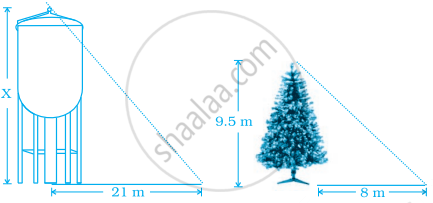
A water tank casts a shadow 21 m long. A tree of height 9.5 m casts a shadow 8 m long at the same time. The lengths of the shadows are directly proportional to their heights. Find the height of the tank.
Kusum always forgets how to convert miles to kilometres and back again. However she remembers that her car’s speedometer shows both miles and kilometres. She knows that travelling 50 miles per hour is same as travelling 80 kilometres per hour. To cover a distance of 200 km, how many miles Kusum would have to go?
