मराठी
कर्नाटक बोर्ड पी.यू.सी.पीयूसी विज्ञान इयत्ता ११

The Potentiometer Wire Ab Shown in the Figure is 50 Cm Long. When Ad = 30 Cm, No Deflection Occurs in the Galvanometer. Find R. - Physics

Advertisements
Advertisements

प्रश्न

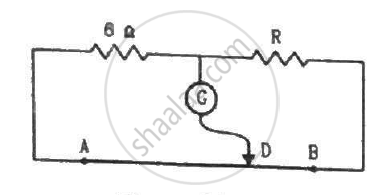
The potentiometer wire AB shown in the figure is 50 cm long. When AD = 30 cm, no deflection occurs in the galvanometer. Find R.
बेरीज
Advertisements

उत्तर

It is given that at point D, there is no deflection in the galvanometer, i.e. the bridge is balanced

\[\Rightarrow \frac{R_{AD}}{R_{DB}} = \frac{6}{R}\]

According to the principle of a potentiometer,

\[\frac{R_{AD}}{R_{DB}} = \frac{l_{AD}}{l_{DB}}\]

\[ \Rightarrow \frac{6}{R} = \frac{30}{20}\]

\[ \Rightarrow R = \frac{20 \times 6}{30} = 4  \Omega\]

shaalaa.com
Potentiometer
  या प्रश्नात किंवा उत्तरात काही त्रुटी आहे का?
पाठ 10: Electric Current in Conductors - Exercises [पृष्ठ २०२]

APPEARS IN

एचसी वर्मा Concepts of Physics Vol. 2 [English] Class 11 and 12
पाठ 10 Electric Current in Conductors
Exercises | Q 54 | पृष्ठ २०२

संबंधित प्रश्‍न

State the principle of a potentiometer. Define potential gradient. Obtain an expression for potential gradient in terms of resistivity of the potentiometer wire.


In the figure a long uniform potentiometer wire AB is having a constant potential gradient along its length. The null points for the two primary cells of emfs ε1 and ε2 connected in the manner shown are obtained at a distance of 120 cm and 300 cm from the end A. Find (i) ε1/ ε2 and (ii) position of null point for the cell ε1.

How is the sensitivity of a potentiometer increased?


Would you prefer a voltmeter or a potentiometer to measure the emf of a battery?


In a potentiometer experiment, the balancing length with a resistance of 2Ω is found to be 100 cm, while that of an unknown resistance is 500 cm. Calculate the value of the unknown resistance. 


When the balance point is obtained in the potentiometer, a current is drawn from ______.


Define potential gradient of the potentiometer wire.


State any one use of a potentiometer.


Select the WRONG statement:


A potentiometer wire of Length 10 m is connected in series with a battery. The e.m.f. of a cell balances against 250 cm Length of wire. If length of potentiometer wire is increased by 1 m, the new balancing length of wire will be ____________.


A potentiometer wire of length 100 cm has a resistance of 10 `Omega.` It is connected in series with a resistance and an accumulator of e.m.f 2 V and of negligible internal resistance. A source of e.m.f 10 mV is balanced against a 40 cm length of the potentiometer wire. The value of the external resistance is ____________.


The length of a wire of a potentiometer is 100 cm, and the e.m.f of its standard cell is E volt. It is employed to measure the e.m.f of a battery whose internal resistance is 0.5 `Omega` If the balance point is obtained at `l`= 30 cm from the positive end, the e.m.f of the battery is ____________.

where 'i' is the current in the potentiometer


A potentiometer is used to measure the potential difference between A and B, the null point is obtained at 0.9 m. Now the potential difference between A and C is measured, the null point is obtained at 0.3 m. The ratio `E_2/E_1` is (E1 > E2) ______


If the length of potentiometer wire is increased, then the length of the previously obtained balance point will ______.


AB is a wire of potentiometer with the increase in value of resistance R, the shift in the balance point J will be:


A wire of resistance R is cut into two equal part. There parts are then connected in parallel. The equivalent resistance of the combination will be


Consider a simple circuit shown in figure   stands for a variable resistance R′. R′ can vary from R0 to infinity. r is internal resistance of the battery (r << R << R0).

  1. Potential drop across AB is nearly constant as R ′ is varied.
  2. Current through R′ is nearly a constant as R ′ is varied.
  3. Current I depends sensitively on R′.
  4. `I ≥ V/(r + R)` always.

In an experiment with a potentiometer, VB = 10V. R is adjusted to be 50Ω (Figure). A student wanting to measure voltage E1 of a battery (approx. 8V) finds no null point possible. He then diminishes R to 10Ω and is able to locate the null point on the last (4th) segment of the potentiometer. Find the resistance of the potentiometer wire and potential drop per unit length across the wire in the second case.


A Daniel cell is balanced on 125 cm lengths of a potentiometer wire. Now the cell is short circuited by a resistance 2 Ω and the balance is obtained at 100 cm. The internal resistance of the Daniel cell is ______.


What is the effect of decreasing the current through the potentiometer on the null point?


A particle carrying 8 electron charges starts from rest and is accelerated through a potential difference of 9000 V. Calculate the KE acquired by it in keV.


Share
Notifications

Englishहिंदीमराठी


      Forgot password?
Use app×