Advertisements
Advertisements
प्रश्न
The living organisms can be unexceptionally distinguished from the non-living things on the basis of their ability for ______.
पर्याय
responsiveness to touch
interaction with the environment and progressive evolution
reproduction
growth and movement
Advertisements
उत्तर
The living organisms can be unexceptionally distinguished from the non-living things on the basis of their ability for reproduction.
APPEARS IN
संबंधित प्रश्न
Write the functions of the following organs of reproduction:
a. Ovaries
b. Seminal vesicle and prostate glands
Draw a sectional view of human female reproductive system and label the part where
(i) eggs develop.
(ii) fertilisation takes place.
(iii) fertilised egg gets implanted.
The diagram shown below is the longitudinal section of a testis of man. Study it carefully and answer the questions that follow

(i) Label the parts numbered 1 to 3 in the diagram.
(ii) In which part of the testis are the sperms produced?
(iii) State the functions of the parts labelled 1 and 3 in the diagram.
Give scientific reasons: When an ovum gets fertilized, menstrual cycle stops temporarily in a woman.
fill in the blanks with suitable functions: Seminiferous Tubule and _____
Choose the ODD one out from the following terms given and name the CATEGORY to which the others belong:
Prostate gland, Cowper’s gland, seminal vesicle, seminiferous tubules.
Trace the path of sperms from where they are produced in human body to the exterior.
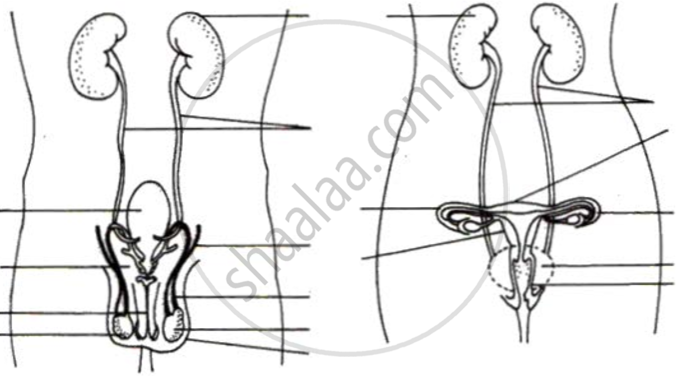
Label the folowing diagram
Column ‘II’ is a list of items related to ideas in Column ‘I’. Match the term in Column ‘II’ with a suitable idea given in Column ‘I’.
| Column I | Column II |
| (i) Acrosome
(ii) Ovulation (iii) Sperm (iv) Menopause (v) Implantation (vi) Fertilization (vii) Contraception in males |
(a) Male gamete
(b) Oviduct (c) Uterus (d) Spermatozoa (e) Progesterone (f) Stoppage of the menstrual cycle (g) Sudden change in genes |
Cryptorchidism is a condition where ______.
