Advertisements
Advertisements
प्रश्न
The length of the diagonals of a cube is 8√3 cm.
Find its:
(i) edge
(ii) total surface area
(iii) Volume
Advertisements
उत्तर
(i) Length of diagonal of a cube = `8sqrt(3)` cm
Length of edge = `(8sqrt(3))/sqrt(3)` = 8 cm
(ii) Total surface area = 6a2 = 6 x 82 = 6 x 64 cm2 = 384 cm2
(iii) Volume = a3 = (8)3= 512 cm3
APPEARS IN
संबंधित प्रश्न
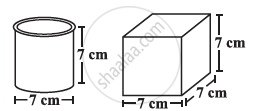
Describe how the two figures at the right are alike and how they are different. Which box has larger lateral surface area?
A beam 5 m long and 40 cm wide contains 0.6 cubic metre of wood. How thick is the beam?
Fill in the blank in the following so as to make the statement true:
The volume of a wooden cuboid of length 10 cm and breadth 8 cm is 4000 cm3. The height of the cuboid is ........ cm.
Fill in the blank in the following so as to make the statement true:
1 ml = ........ cu. cm
Cubes A, B, C having edges 18 cm, 24 cm and 30 cm respectively are melted and moulded into a new cube D. Find the edge of the bigger cube D.
The volume of a cube is 729 cm3. Find its total surface area.
The length, breadth, and height of a cuboid are in the ratio 6: 5 : 3. If its total surface area is 504 cm2, find its volume.
Find the T.S.A and L.S.A of the cube whose side is 21 cm
Find the T.S.A and L.S.A of the cube whose side is 7.5 cm
The lateral surface area of a cube is 256 m2. The volume of the cube is ______.
