The length, breadth and depth of a pond are 20.5 m, 16 m and 8 m respectively. Find the capacity of the pond in litres
Advertisements
प्रश्न
The length, breadth and depth of a pond are 20.5 m, 16 m and 8 m respectively. Find the capacity of the pond in litres
Advertisements
उत्तर
Length of a pond (l) = 20.5 m
Breadth of a pond (b) = 16 m
Depth of a pond (h) = 8 m
Volume of the pond = l × b × h cu.units
= 20.5 × 16 × 8 m3
= 2624 m3 ...[1 cu.m = 1000 litres]
= (2624 × 1000) litres
= 2624000 litres
APPEARS IN
संबंधित प्रश्न
A cuboidal water tank is 6 m long, 5 m wide and 4.5 m deep. How many litres of water can it hold? (1 m3 = 1000l)
A solid cube of side 12 cm is cut into eight cubes of equal volume. What will be the side of the new cube? Also, find the ratio between their surface areas.
Two cubes, each of volume 512 cm3 are joined end to end. Find the surface area of the resulting cuboid.
Half cubic meter of gold-sheet is extended by hammering so as to cover an area of 1 hectare. Find the thickness of the gold-sheet.
Water in a rectangular reservoir having base 80 m by 60 m i s 6.5 m deep. In what time can the water be emptied by a pipe ôf which the cross-section is a square of side 20 cm, if the water runs through the pipe at the rate of 15 km/hr.
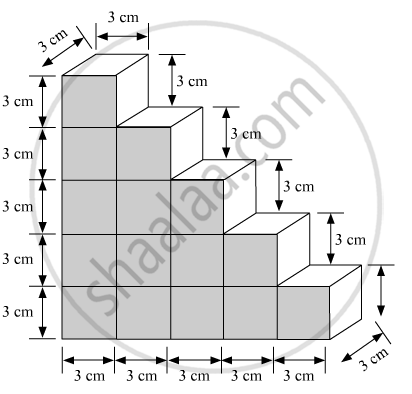
A child playing with building blocks, which are of the shape of the cubes, has built a structure as shown in Fig. 18.12 If the edge of each cube is 3 cm, find the volume of the structure built by the child.
Find the volume of a cuboid whose dimensions are length = 12 cm, breadth = 8 cm, height = 6 cm
How many small cubes with edge of 20 cm each can be just accommodated in a cubical box of 2 m edge?
Ramesh has three containers.
- Cylindrical container A having radius r and height h,
- Cylindrical container B having radius 2r and height 1/2 h, and
- Cuboidal container C having dimensions r × r × h
The arrangement of the containers in the increasing order of their volumes is
