Advertisements
Advertisements
प्रश्न
A cuboidal water tank is 6 m long, 5 m wide and 4.5 m deep. How many litres of water can it hold? (1 m3 = 1000l)
Advertisements
उत्तर
The given cuboidal water tank has its length (l) as 6 m, breadth (b) as 5 m, and height (h) as 4.5 m.
Volume of tank = l × b × h
= (6 × 5 × 4.5) m3
= 135 m3
Amount of water that 1 m3 volume can hold = 1000 liters
Amount of water that 135 m3 volume can hold = (135 × 1000) litres = 135000 litres
Therefore, such a tank can hold up to 135000 liters of water.
संबंधित प्रश्न
Find the cost of digging a cuboidal pit 8 m long, 6 m broad and 3 m deep at the rate of Rs 30 per m3.
The areas of three adjacent faces of a cuboid are x, y and z. If the volume is V, prove that
`V^2` = `xyz`
Half cubic meter of gold-sheet is extended by hammering so as to cover an area of 1 hectare. Find the thickness of the gold-sheet.
A rectangular tank is 80 m long and 25 m broad. Water flows into it through a pipe whose cross-section is 25 cm2, at the rate of 16 km per hour. How much the level of the water rises in the tank in 45 minutes.
Find the volume of a cuboid whose dimensions are length = 60 m, breadth = 25 m, height = 1.5 m
The dimensions of a match box are 6 cm × 3.5 cm × 2.5 cm. Find the volume of a packet containing 12 such match boxes
The volume of a container is 1440 m3. The length and breadth of the container are 15 m and 8 m respectively. Find its height
Volume of regular solids such as cube and cuboid can be found by multiplying the dimensions. Complete the given table by finding the volume of the given objects
| S.No. | Objects | l | b | h | Volume (cubic cm) |
| 1. | Note books | 6 cm | 15 cm | 1 cm | |
| 2. | Name board | 20 cm | 90 cm | 2 cm | |
| 3. | Show case cub board | 70 cm | 250 cm | 70 cm | |
| 4. | Gift box | 10 cm | 10 cm | 10 cm | |
| 5. | Dice | 1 cm | 1 cm | 1 cm |
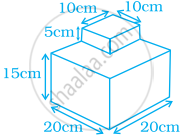
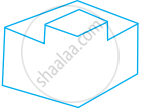
A birthday cake has two tiers as shown in the figure below. Find the volume of the cake.
 |
 |
Water flows from a tank with a rectangular base measuring 80 cm by 70 cm into another tank with a square base of side 60 cm. If the water in the first tank is 45 cm deep, how deep will it be in the second tank?
