Advertisements
Advertisements
प्रश्न
The Frog and the Nightingale is a spoof on the present society. Study the Mind Map given below. Divide yourselves into groups, select a box and discuss the statement given. Then present your views to the class.
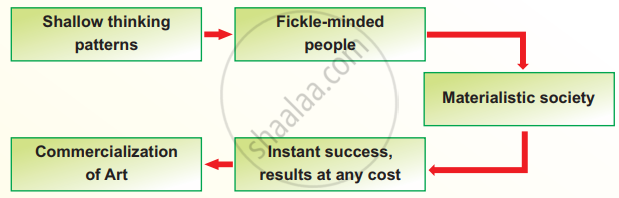
Topics for CLASS DISCUSSION
a. How a person tries to put down another when that person is succeeding in his or her life.
b. Our self-image is often based on what others make us believe we are. A poor selfimage can do irreparable damage to us. Do you agree with this statement?
Elaborate with suitable reasons and examples.
Advertisements
उत्तर
Instant Success, results at any cost
Group 1
In today’s ‘fast food’ world, people want everything in the wink of an eye. They chase after unmaterialistic goals and end up wasting their precious time and energy But in my opinion, to be successful in life, the quality of perseverance plays an important role.
Group 2
Success requires a person to accept responsibility and thinking that you will get success instantly is nothing but foolishness. Always remember that everything comes at a price. Passion, perseverance and perfection are the things that ensure success to a person.
Group 3
There is nothing like ‘Instant success! In order to reach the highest level in any of the thing, proper practice and training are must. But unfortunately, modern society is incredibly impatient and want everything overnight. They must relax and take their time to get the results of their endeavours. A sustained but continuous effort is sure to give you good results.
(This is a model answer. Responses may vary)
Class Discussion
A poor self-image can do irrepairable damage to us. I fully agree with this statement and want to put before you a very wise quote by Albert Einstein. ‘Everybody is a genius. But if you judge a fish by its ability to climb a tree, it will live its whole life believing that it is stupid. We often tend to fear “what do people think about us?
APPEARS IN
संबंधित प्रश्न
Have you come across people who are not what they seem to be - like someone who is extremely friendly and helpful yet you are not very comfortable with him / her as you feel it is a put-on? Have a class discussion about such people and why you feel as you do.
Before you read the poem complete the word - web with the words that we associate with a Frog and a Nightingale
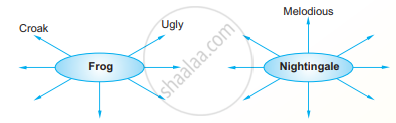
The following is a summary of the poem but it is jumbled up. Write out the events in their correct order to form a continuous paragraph.
(a) As a result, her voice lost its beauty, and the other creatures stopped coming to hear her sing.
(b) Soon the nightingale became famous, and creatures from miles around came to hear her sing.
(c) All the creatures in the bog cheered and clapped at her beautiful song.
(d) He offered to train the nightingale, so that she could sing even more beautifully.
(e) So the frog could sing unrivalled in the bog once more.
(f) The next night the frog introduced himself.
(g) The frog charged an admission fee, and earned a lot of money from these concerts.
(h) A frog croaked all night in a bog, in an unpleasant voice.
(i) But the frog made the nightingale rehearse continuously in the rain.
(j) One night a nightingale began to sing in a melodious voice.
(k) Finally, the nightingale burst a vein and died.
Now that you have read the poem, add more personality traits to the word-web of the frog and the nightingale as depicted in the poem. Then complete the given table. (Some of the words in the box below may help you. You may also use the words given in Q. 1.)
| Character | Extract | Personality traits |
| Nightingale | Sorry - was that you who spoke? | Polite, Timorous |
| Frog |
Yes,… you see, I'm the frog who owns this tree In this bog I've long been known For my splendid baritone. |
|
| Nightingale | Did you…did you like my song? | |
| Frog | Not too bad - but far too long The technique was fine, of course, But it lacked a certain force. | |
| Frog | Without proper training such as I And a few others can supply You'll remain a mere beginner, But with me you'll be a winner. | |
| Nightingale | But I can't sing in this weather | |
| Nightingale | …This is a fairy tale - And you're Mozart in disguise Come to earth before my eyes. | |
| Frog | Come, my dear - we'll sing together. | |
| Frog | We must aim for better billing You still owe me sixty shillings. |
|
| Frog | Brainless bird - you're on the stage Use your wits and follow fashion. Puff your lungs out with your passion. | |
| Frog | …I tried to teach her, But she was a stupid creature. |
| Dismissive Nervous Timid Presumptuous Superior Fawning Shy Polite Meek Possessive Dominating Mercenery |
Divide yourselves into groups of four or five and brainstorm on any one of the given situations in order to create an imaginary dialogue or a comic strip. Keep in mind the characters and situations while doing so. Representatives from each group could then present the dialogues / read them to the class.
| Situations a. The efforts made by the other creatures of the bog to still the frog's determination 'to display his heart's elation'. b. The first time the Nightingale sings. c. The nightingale is awestruck when the frog introduces himself. d. The practice session when it is raining. e. The nightingale is reprimanded by the frog when the box office crashes. |
The frog’s ultimate aim was to ______.
The animals’ reaction to the nightingale’s song caused the frog to ______.
Identify the reason why the nightingale accepted the frog’s tutelage.
Which are the different ways in which the frog asserts his importance?
Discuss the following question and write the answer in your note-books.
Bring out the irony in the frog's statement - 'Your song must be your own'.
Discuss the following question and write the answer in your note-books.
Do you think the nightingale is 'brainless'? Give reasons for your answer.
The nightingale has scaled the heights of success. But now the audience is dwindling, the frog is unhappy and reprimands her all the time. She is mentally and physically exhausted and fears failure. As the nightingale, write a diary entry highlighting her fears and analyzing the reasons for her failure.
Write an obituary for the nightingale. You may begin like this: May the kind soul……… (or you may make use of your own beginning)
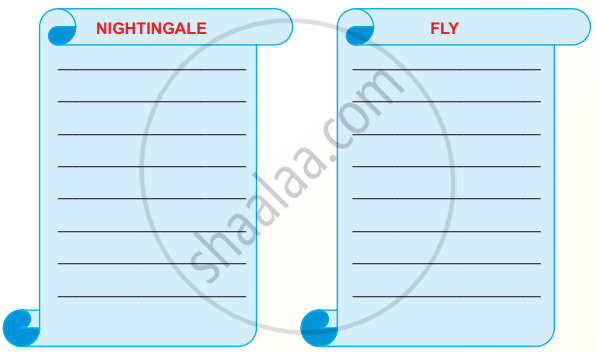
Listen to your teacher recite the poem The Spider and the Fly by Mary Howitt and compare the Fly to Vikram Seth's Nightingale.
Read the extract given below and answer the questions that follow:
"You must make your public happier :
Give them something, sharper, snappier.
We must aim for better billings."
(a) Identify the speaker of the above lines.
(b) Who does 'we' refer to?
(c) What must be done for 'better billings'
(d) What trait of the speaker's character is revealed through the above lines?
