Advertisements
Advertisements
प्रश्न
The equation of a travelling sound wave is y = 6.0 sin (600 t − 1.8 x) where y is measured in 10−5 m, t in second and x in metre. (a) Find the ratio of the displacement amplitude of the particles to the wavelength of the wave. (b) Find the ratio of the velocity amplitude of the particles to the wave speed.
Advertisements
उत्तर
Given:
Equation of a travelling sound wave is y = 6.0 sin (600 t − 1.8 x),
where y is measured in 10−5 m,
t in second,
x in metre.
Comparing the given equation with the wave equation, we find:
Amplitude A = 6 \[\times\]10-5 m
\[(a) \text{ We have: } \]
\[ \frac{2\pi}{\lambda} = 1 . 8 \]
\[ \Rightarrow \lambda = \left( \frac{2\pi}{1 . 8} \right)\]
\[\text { So, required ratio: } \]
\[ \frac{A}{\lambda} = \frac{6 . 0 \times (1 . 8) \times {10}^{- 5} m/s}{(2\pi)} = 1 . 7 \times {10}^{- 5} m\]
(b) Let Vy be the velocity amplitude of the wave.
\[\text { Velocity v }= \frac{dy}{dt}\]
\[v = \frac{d\left[ 6 \sin \left( 600 t - 1 . 8 x \right) \right]}{dt}\]
\[ \Rightarrow v = 3600 \cos (600t - 1 . 8x) \times {10}^{- 5} m/s\]
\[\text { Amplitute } V_y = 3600 \times {10}^{- 5} m/s\]
\[\text { Wavelength: }\]
\[ \lambda = \frac{2\pi}{1 . 8}\]
\[\text { Time period: } \]
\[T = \frac{2\pi}{\omega}\]
\[ \Rightarrow T = \frac{2\pi}{600}\]
\[\text { Wave speed v } = \frac{\lambda}{T}\]
\[ \Rightarrow v = \frac{600}{1 . 8} = \frac{100}{3} m/s\]
\[\text { Required ratio: } \]
\[\left( \frac{V_y}{v} \right) = \frac{3600 \times 3 \times {10}^{- 5}}{1000} = 1 . 1 \times {10}^{- 4} m\]
APPEARS IN
संबंधित प्रश्न
Explain what is Doppler effect in sound
The wavelengths of two sound waves in air are `81/173`m and `81/170`m. They produce 10 beats per second. Calculate the velocity of sound in air
A wave is represented by an equation \[y = c_1 \sin \left( c_2 x + c_3 t \right)\] In which direction is the wave going? Assume that \[c_1 , c_2\] \[c_3\] are all positive.
A string clamped at both ends vibrates in its fundamental mode. Is there any position (except the ends) on the string which can be touched without disturbing the motion? What if the string vibrates in its first overtone?
The equation \[y = A \sin^2 \left( kx - \omega t \right)\]
represents a wave motion with
If you are walking on the moon, can you hear the sound of stones cracking behind you? Can you hear the sound of your own footsteps?
The fundamental frequency of a vibrating organ pipe is 200 Hz.
(a) The first overtone is 400 Hz.
(b) The first overtone may be 400 Hz.
(c) The first overtone may be 600 Hz.
(d) 600 Hz is an overtone.
A steel tube of length 1.00 m is struck at one end. A person with his ear closed to the other end hears the sound of the blow twice, one travelling through the body of the tube and the other through the air in the tube. Find the time gap between the two hearings. Use the table in the text for speeds of sound in various substances.
At what temperature will the speed of sound be double of its value at 0°C?
Calculate the bulk modulus of air from the following data about a sound wave of wavelength 35 cm travelling in air. The pressure at a point varies between (1.0 × 10⁵ ± 14) Pa and the particles of the air vibrate in simple harmonic motion of amplitude 5.5 × 10⁻⁶ m.
Sound with intensity larger than 120 dB appears pain full to a person. A small speaker delivers 2.0 W of audio output. How close can the person get to the speaker without hurting his ears?
A particular guitar wire is 30⋅0 cm long and vibrates at a frequency of 196 Hz when no finger is placed on it. The next higher notes on the scale are 220 Hz, 247 Hz, 262 Hz and 294 Hz. How far from the end of the string must the finger be placed to play these notes?
Three sources of sound S1, S2 and S3 of equal intensity are placed in a straight line with S1S2 = S2S3. At a point P, far away from the sources, the wave coming from S2 is 120° ahead in phase of that from S1. Also, the wave coming from S3 is 120° ahead of that from S2. What would be the resultant intensity of sound at P?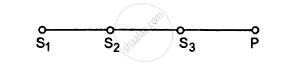
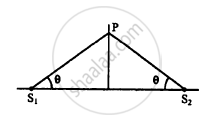
Two sources of sound S1 and S2 vibrate at same frequency and are in phase. The intensity of sound detected at a point P as shown in the figure is I0. (a) If θ equals 45°, what will be the intensity of sound detected at this point if one of the sources is switched off? (b) What will be the answer of the previous part if θ = 60°?
In a standing wave pattern in a vibrating air column, nodes are formed at a distance of 4.0 cm. If the speed of sound in air is 328 m s−1, what is the frequency of the source?
A source of sound with adjustable frequency produces 2 beats per second with a tuning fork when its frequency is either 476 Hz of 480 Hz. What is the frequency of the tuning fork?
A car moves with a speed of 54 km h−1 towards a cliff. The horn of the car emits sound of frequency 400 Hz at a speed of 335 m s−1. (a) Find the wavelength of the sound emitted by the horn in front of the car. (b) Find the wavelength of the wave reflected from the cliff. (c) What frequency does a person sitting in the car hear for the reflected sound wave? (d) How many beats does he hear in 10 seconds between the sound coming directly from the horn and that coming after the reflection?
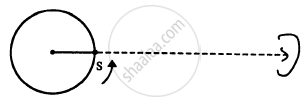
A small source of sound S of frequency 500 Hz is attached to the end of a light string and is whirled in a vertical circle of radius 1.6 m. The string just remains tight when the source is at the highest point. (a) An observer is located in the same vertical plane at a large distance and at the same height as the centre of the circle. The speed of sound in air = 330 m s−1 and g = 10 m s−2. Find the maximum frequency heard by the observer. (b) An observer is situated at a large distance vertically above the centre of the circle. Find the frequency heard by the observer corresponding to the sound emitted by the source when it is at the same height as the centre.
Which of the following statements are true for wave motion?
A transverse wave is represented by y = 2sin (ωt - kx) cm. The value of wavelength (in cm) for which the wave velocity becomes equal to the maximum particle velocity, will be ______.
