Advertisements
Advertisements
प्रश्न
The dimensions of a cinema hall are 100 m, 50 m and 18 m. How many persons can sit in the hall, if each person requires 150 m3 of air?
Advertisements
उत्तर
\[\text { The dimensions of a cinema hall are 100 m } \times 50 m \times 18 m . \]
\[\text { i . e . , volume of air in the cinema hall }= 100 \times 50 \times 18 = 90000 m^3 \]
\[\text { It is given that each person requires 150 } m^3 \text { of air } . \]
\[ \therefore \text { The number of persons that can sit in the cinema hall }= \frac{\text { volume of air in hall }}{\text { volume of air required by 1 person }} = \frac{90000}{150} = 600\]
संबंधित प्रश्न
A small indoor greenhouse (herbarium) is made entirely of glass panes (including base) held together with tape. It is 30 cm long, 25 cm wide and 25 cm high. How much of tape is needed for all the 12 edges?
Find the lateral surface area and total surface area of a cube of edge 10 cm.
An ice-cream brick measures 20 cm by 10 cm by 7 cm. How many such bricks can be stored in deep fridge whose inner dimensions are 100 cm by 50 cm by 42 cm?
The dimensions of an oil tin are 26 cm × 26 cm × 45 cm. Find the area of the tin sheet required for making 20 such tins. If 1 square metre of the tin sheet costs Rs 10, find the cost of tin sheet used for these 20 tins.
The length, breadth and height of a rectangular solid are in the ratio 5 : 4 : 2. If the total surface area is 1216 cm2, find the length, the breadth and the height of the solid.
75 persons can sleep in a room 25 m by 9.6 m. If each person requires 16 m3 of the air; find the height of the room.
Find the area of metal-sheet required to make an open tank of length = 10 m, breadth = 7.5 m and depth = 3.8 m.
An open box of length 1.5 m, breadth 1 m, and height 1 m is to be made for use on a trolley for carrying garden waste. How much sheet metal will be required to make this box? The inside and outside surface of the box is to be painted with rust-proof paint. At a rate of 150 rupees per sqm, how much will it cost to paint the box?
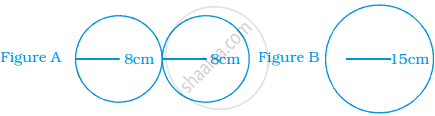
Below are the drawings of cross sections of two different pipes used to fill swimming pools. Figure A is a combination of 2 pipes each having a radius of 8 cm. Figure B is a pipe having a radius of 15 cm. If the force of the flow of water coming out of the pipes is the same in both the cases, which will fill the swimming pool faster?