Advertisements
Advertisements
प्रश्न
The diagram given below is that of a developing human foetus in the womb. Study the same and then answer the questions that follow:
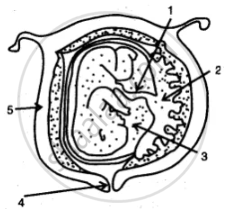
- Name the parts '1' to '5' indicated by guidelines.
- What term is given to the period of development of the foetus in the womb?
- How many days does the foetus take to be fully developed?
- Mention two functions of the parts labelled ‘2’ other than its endocrine function.
- Name the hormone (anyone) produced by the part labelled ‘2’.
- What is the function of the part marked ‘3’?
Advertisements
उत्तर
-
- Umbilical cord
- Placenta
- Amniotic fluid
- Cervix
- Uterus wall
- Gestation period.
- 280 days.
- It provides nutrition and the exchange of respiratory gases by diffusion.
- Prevents foetuses from jerks and shocks. It also prevents the foetus from sticking to the uterine wall.
Notes
Student should refer their answer according to their question
संबंधित प्रश्न
State whether the following statements are TRUE (T) or FALSE (F):
Rewrite the wrong statement by correcting only one word either at the beginning or at the end of the sentence.
Uterus is also known as birth canal.
Given below is the name of certain stage/substance related to reproduction and found in human body. Answer the questions related to it.
Placenta
- What are the two sources that form placenta?
- Name any two main substances which pass from foetus to mother through placenta.
- Name any two hormones it produces.
The circulatory system of the fetus and that of the mother are never connected directly. What are the advantages?
Differentiate
Uterus and Urethra.
Study the diagram given below and then answer the questions that follow:
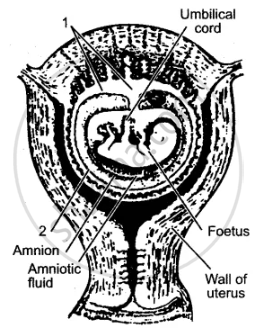
(i) Name the parts labeled 1 and 2. State the function of each part.
(ii) State any one function of the amniotic fluid.
(iii) What is the role of the umbilical cord in the development of the fetus?
(iv) Name the part in the diagram which is endocrine in nature.
Give Technical Term:
A structure which connects the placenta with the fetus.
Complete the following sentences with appropriate word:
The period of complete development of the fetus until birth is termed ______.
Write the functional activity of the following structure:
Uterus
Match the respiratory surfaces to the organisms in which they are found.
| Organ/ cells | Hormones | ||
| (i) | Corpus luteum | (a) | HCG |
| (ii) | Leydig's cells | (b) | Estrogen |
| (iii) | Placenta | (c) | Progesterone |
| (iv) | Graafian follicle | (d) | Testosterone |
Mother's blood flows into the foetus through placenta.
