Advertisements
Advertisements
प्रश्न
The diagram below represents an experiment to demonstrate a certain phenomenon in a green plant:
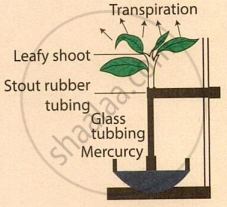
- Will the level of mercury in the glass tubing rise or fall?
- Which conducting tissue of the plant does the glass-tubing represent?
- Define transpiration.
- How will the rate of the above process differ if the environment of the plant has
- Less humidity
- High temperature?
सविस्तर उत्तर
Advertisements
उत्तर
- The level of mercury in the glass tubing will rise. This happens because as the leafy shoot loses water through transpiration, it creates a suction force called a transpiration pull that draws the water column—and consequently the mercury—upward into the tube.
- The glass tubing represents the xylem tissue of the plant, which is responsible for the upward conduction of water and dissolved minerals from the roots to the leaves.
- Transpiration is defined as the loss of water in the form of water vapor from the aerial parts (such as leaves and stems) of a living plant.
-
- Less humidity: The rate of transpiration will increase because dry air creates a steeper moisture gradient between the inside of the leaf and the outside atmosphere, allowing water vapor to diffuse out faster.
- High temperature: The rate of transpiration will increase because a higher temperature accelerates the rate of water evaporation from the mesophyll cells into the internal air spaces of the leaf.
shaalaa.com
या प्रश्नात किंवा उत्तरात काही त्रुटी आहे का?
