Advertisements
Advertisements
प्रश्न
The curved surface area and the volume of a toy, cylindrical in shape, are 132 cm2 and 462 cm3 respectively. Find, its diameter and its length.
Advertisements
उत्तर
Let the radius of a toy = r and
height of the toy = h
The curved surface area of a toy = 132 cm2
=> 2πrh = 132 cm2
⇒ `2pirh = 132` cm2
⇒ `r = 132/(2pi xx h)` cm2 ...(i)
Also, volume of a toy = 462 cm3
⇒ `pir^2h = 462` cm3
⇒ `r^2 = 462/(pi xx h)` ...(ii)
Now, substitute the volume of r, we get
`(132)^2/((2)^2 xx (pi)^2 xx h^2) = 462/(pi xx h)`
⇒ `132^2/(4 xx pi xx h) = 462`
⇒ `4 xx pi xx h = (132 xx 132)/462`
⇒ `h = (132 xx 132)/(462 xx pi xx h)`
⇒ `h = (132 xx 132 xx 7)/(462 xx 22 xx 4) = 3` cm
Now, put the value of h in eq. (i), we get
`r = (132 xx 7)/(2 xx 22 xx 3) = 7` cm
∴ Diameter of the toy = `2 xx r`
= `2 xx 7` cm = 14 cm
- Diameter: 14 cm
- Length (Height): 3 cm
APPEARS IN
संबंधित प्रश्न
A small indoor greenhouse (herbarium) is made entirely of glass panes (including base) held together with tape. It is 30 cm long, 25 cm wide and 25 cm high. How much of tape is needed for all the 12 edges?
Parveen wanted to make a temporary shelter for her car, by making a box-like structure with tarpaulin that covers all the four sides and the top of the car (with the front face as a flap which can be rolled up). Assuming that the stitching margins are very small, and therefore negligible, how much tarpaulin would be required to make the shelter of height 2.5 m, with base dimensions 4 m × 3 m?
Hameed has built a cubical water tank with lid for his house, with each other edge 1 .5 m long. He gets the outer surface of the tank excluding the base, covered with square tiles of side 25 cm. Find how much he would spend for the tiles, if the cost of tiles is Rs. 360 per dozen.
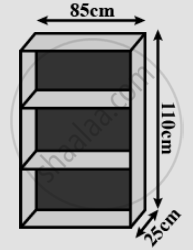
A wooden bookshelf has external dimensions as follows: Height = 110 cm, Depth = 25 cm, Breadth = 85 cm in following figure. The thickness of the plank is 5 cm everywhere. The external faces are to be polished and the inner faces are to be painted. If the rate of polishing is 20 paise per cm2 and the rate of painting is 10 paise per cm2. Find the total expenses required for polishing and painting the surface of the bookshelf.
Find the volume of a cuboid whose length =1.2 m, breadth = 30 cm, height = 15 cm.
Find the volume of a cuboid whose length = 15 cm, breadth = 2.5 dm, height = 8 cm.
How many wooden cubical blocks of side 25 cm can be cut from a log of wood of size 3 m by 75 cm by 50 cm, assuming that there is no wastage?
Find the volume in cubic metre (cu. m) of the cuboid whose dimensions is length = 10 m, breadth = 25 dm, height = 50 cm.
How many bricks each of size 25 cm × 10 cm × 8 cm will be required to build a wall 5 m long, 3 m high and 16 cm thick, assuming that the volume of sand and cement used in the construction is negligible?
A village, having a population of 4000, requires 150 litres water per head per day. It has a tank which is 20 m long, 15 m broad and 6 m high. For how many days will the water of this tank last?
The perimeter of a floor of a room is 30 m and its height is 3 m. Find the area of four walls of the room.
A rectangular water reservoir contains 105 m3 of water. Find the depth of the water in the reservoir if its base measures 12 m by 3.5 m.
The dimensions of a rectangular box are in the ratio of 2 : 3 : 4 and the difference between the cost of covering it with sheet of paper at the rates of Rs 8 and Rs 9.50 per m2 is Rs. 1248. Find the dimensions of the box.
Find the edge of a cube whose surface area is 432 m2.
Three equal cubes are placed adjacently in a row. The ratio of the total surface area of the resulting cuboid to that of the sum of the surface areas of three cubes, is
If each edge of a cuboid of surface area S is doubled, then surface area of the new cuboid is
Volume of a cuboid is 12 cm3. The volume (in cm3) of a cuboid whose sides are double of the above cuboid is
The volume of a cuboid is 7.68 m3. If its length = 3.2 m and height = 1.0 m; find its breadth.
The length, breadth, and height of a cuboid are in the ratio 5 : 3: 2. If its volume is 240 cm3; find its dimensions. Also, find the total surface area of the cuboid.
Find the length of each edge of a cube, if its volume is :
(i) 216 cm3
(ii) 1.728 m3
Find the volume of wood required to make a closed box of external dimensions 80 cm, 75 cm, and 60 cm, the thickness of walls of the box being 2 cm throughout.
Find the area of metal-sheet required to make an open tank of length = 10 m, breadth = 7.5 m and depth = 3.8 m.
A cuboid is 8 m long, 12 m broad and 3.5 high, Find its
(i) total surface area
(ii) lateral surface area
The length and breadth of a cuboid are 20 cm and 15 cm respectively. If its volume is 2400 cm3, find its height.
A metallic sheet is of the rectangular shape with dimensions 48cm x 36cm. From each one of its corners, a square of 8cm is cutoff. An open box is made of the remaining sheet. Find the volume of the box.
How much sheet metal is required to make a closed rectangular box of length 1.5 m, breadth 1.2 m, and height 1.3 m?
The surface area of a cuboid formed by joining two cubes of side a face to face is ______.
