Advertisements
Advertisements
प्रश्न
The ciliated epithelium lines the______.
पर्याय
Skin
Digestive tract
Gall bladder
Trachea
Advertisements
उत्तर
The ciliated epithelium lines the Trachea.
संबंधित प्रश्न
Describe various types of epithelial tissues with the help of labelled diagrams
Based on the following information, identify the three types of epithelial tissue in the figures given below :
| a | 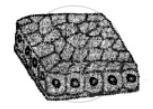 |
b | 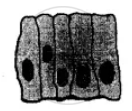 |
c | 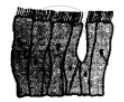 |
(1) Cuboidal epithelium: It consists of a single layer of cuboidal cells.
(2) Columnar epithelium: It is composed of tall, cylindrical cells with oval nuclei usually placed at the base of the cells.
(3) Ciliated epithelium: It consists of cells being hair-like cilia on their free surface.
Fill in the blank
Epithelial tissue is made of cells without any ...................... spaces.
Name one place in living organisms where the following tissues is located:
Squamous epithelium
Name one place in living organisms where the following tissue is located:
Ciliated epithelium
Give structure, types and functions in brief of the following:
Epithelial tissue
Name the tissues found:
in the testes and ovaries.
State whether true or false. If false, correct the statement.
Epithelial tissue is protective tissue in animal body.
What is an epithelium? Enumerate the characteristic features of different epithelia.
Nerve cell does not contain
Write true (T) or false (F)
Epithelial cells have a lot of intercellular spaces.
Differentiate between sclerenchyma and parenchyma tissues. Draw well labelled diagram.
In a certain type of cell division, the diploid number of chromosomes is reduced to half. This kind of division occurs in ______.
The ______ epithelium is also known as the pavement membrane.
Sieve cells have no companion cells.
Explain simple epithelium and its types.
Which type of tissue CORRECTLY matches with its location?
Write the appropriate type of tissues in column B according to the functions mentioned in column A.
| Column A | Column B |
| a. Secretion and absorption | i. ______ |
| b. Protective covering | ii. ______ |
| c. Linking and supporting framework | iii. ______ |
