मराठी

The Area of the Region { ( X , Y ) : X 2 + Y 2 ≤ 1 ≤ X + Y } is - Mathematics

Advertisements
Advertisements

प्रश्न

The area of the region \[\left\{ \left( x, y \right) : x^2 + y^2 \leq 1 \leq x + y \right\}\] is __________ .

पर्याय

  • \[\frac{\pi}{5}\]

  • \[\frac{\pi}{4}\]

  • \[\frac{\pi}{2} - \frac{1}{2}\]

  • \[\frac{\pi^2}{2}\]

  • None of these

MCQ
Advertisements

उत्तर


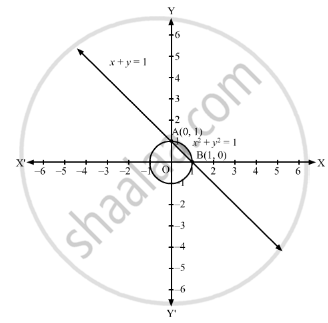
To find the points of intersection of the line and the circle substitute y = 1 − x in x2 + y2 = 1,we get A(0, 1) and B(1, 0).
Therefore, the required area of the shaded region,
\[A = \int_0^1 \left( y_1 - y_2 \right) d x ............\left(\text{Where, }y_1 = \sqrt{1 - x^2}\text{ and }y_2 = 1 - x \right)\]
\[ = \int_0^1 \left[ \left( \sqrt{1 - x^2} \right) - \left( 1 - x \right) \right] d x\]
\[ = = \int_0^1 \left( \sqrt{1 - x^2} - 1 + x \right) d x\]
\[ = \left[ \frac{x}{2}\sqrt{1 - x^2} + \frac{1}{2} \sin^{- 1} \left( x \right) - x + \frac{x^2}{2} \right]_0^1 \]
\[ = \left[ \frac{1}{2}\sqrt{1 - 1^2} + \frac{1}{2} \sin^{- 1} \left( 1 \right) - \left( 1 \right) + \frac{\left( 1 \right)^2}{2} \right] - \left[ \frac{\left( 0 \right)}{2}\sqrt{1 - \left( 0 \right)^2} + \frac{1}{2} \sin^{- 1} \left( 0 \right) - \left( 0 \right) + \frac{\left( 0 \right)^2}{2} \right]\]
\[ = \left( \frac{\pi}{4} - \frac{1}{2} \right)\text{ square units }\]

shaalaa.com
  या प्रश्नात किंवा उत्तरात काही त्रुटी आहे का?
पाठ 21: Areas of Bounded Regions - MCQ [पृष्ठ ६३]

APPEARS IN

आरडी शर्मा Mathematics [English] Class 12
पाठ 21 Areas of Bounded Regions
MCQ | Q 14 | पृष्ठ ६३

व्हिडिओ ट्यूटोरियलVIEW ALL [1]

संबंधित प्रश्‍न

Sketch the region bounded by the curves `y=sqrt(5-x^2)` and y=|x-1| and find its area using integration.


Find the area of the region bounded by the curve x2 = 16y, lines y = 2, y = 6 and Y-axis lying in the first quadrant.


The area bounded by the curve y = x | x|, x-axis and the ordinates x = –1 and x = 1 is given by ______.

[Hint: y = x2 if x > 0 and y = –x2 if x < 0]


Find the area of the region lying in the first quandrant bounded by the curve y2= 4x, X axis and the lines x = 1, x = 4


Find the equation of a curve passing through the point (0, 2), given that the sum of the coordinates of any point on the curve exceeds the slope of the tangent to the curve at that point by 5.


Find the area of ellipse `x^2/1 + y^2/4 = 1`


Make a rough sketch of the graph of the function y = 4 − x2, 0 ≤ x ≤ 2 and determine the area enclosed by the curve, the x-axis and the lines x = 0 and x = 2.


Find the area of the region {(x, y) : y2 ≤ 8x, x2 + y2 ≤ 9}.


Find the area of the region between the circles x2 + y2 = 4 and (x − 2)2 + y2 = 4.


Draw a rough sketch of the region {(x, y) : y2 ≤ 5x, 5x2 + 5y2 ≤ 36} and find the area enclosed by the region using method of integration.


Find the area of the region bounded by the parabola y2 = 2x + 1 and the line x − y − 1 = 0.


Find the area of the region enclosed by the parabola x2 = y and the line y = x + 2.


Find the area of the region bounded by the curve y = \[\sqrt{1 - x^2}\], line y = x and the positive x-axis.


Find the area bounded by the parabola x = 8 + 2y − y2; the y-axis and the lines y = −1 and y = 3.


The area bounded by the parabola x = 4 − y2 and y-axis, in square units, is ____________ .


The area of the region bounded by the parabola (y − 2)2 = x − 1, the tangent to it at the point with the ordinate 3 and the x-axis is _________ .


The area of the region (in square units) bounded by the curve x2 = 4y, line x = 2 and x-axis is


The area bounded by the y-axis, y = cos x and y = sin x when 0 ≤ x ≤ \[\frac{\pi}{2}\] is _________ .


Area of the region bounded by the curve y2 = 4x, y-axis and the line y = 3, is


Find the area bounded by the parabola y2 = 4x and the line y = 2x − 4 By using vertical strips.


Find the equation of the standard ellipse, taking its axes as the coordinate axes, whose minor axis is equal to the distance between the foci and whose length of the latus rectum is 10. Also, find its eccentricity. 


Using integration, find the area of the region bounded by the parabola y= 4x and the circle 4x2 + 4y2 = 9.


Find the area of the region bounded by the parabolas y2 = 6x and x2 = 6y.


Find the area of the region enclosed by the parabola x2 = y and the line y = x + 2


Find the area of the region bounded by the curve y2 = 2x and x2 + y2 = 4x.


Compute the area bounded by the lines x + 2y = 2, y – x = 1 and 2x + y = 7.


The area of the region bounded by the curve y = `sqrt(16 - x^2)` and x-axis is ______.


Find the area of the region bounded by the curve `y^2 - x` and the line `x` = 1, `x` = 4 and the `x`-axis.


Find the area of the region bounded by `y^2 = 9x, x = 2, x = 4` and the `x`-axis in the first quadrant.


The area bounded by the curve `y = x^3`, the `x`-axis and ordinates `x` = – 2 and `x` = 1


Using integration, find the area of the region bounded by the curves x2 + y2 = 4, x = `sqrt(3)`y and x-axis lying in the first quadrant.


For real number a, b (a > b > 0),

let Area `{(x, y): x^2 + y^2 ≤ a^2 and x^2/a^2 + y^2/b^2 ≥ 1}` = 30π

Area `{(x, y): x^2 + y^2 ≥ b^2 and x^2/a^2 + y^2/b^2 ≤ 1}` = 18π.

Then the value of (a – b)2 is equal to ______.


Let the curve y = y(x) be the solution of the differential equation, `("dy")/("d"x) = 2(x + 1)`. If the numerical value of area bounded by the curve y = y(x) and x-axis is `(4sqrt(8))/3`, then the value of y(1) is equal to ______.


Let P(x) be a real polynomial of degree 3 which vanishes at x = –3. Let P(x) have local minima at x = 1, local maxima at x = –1 and `int_-1^1 P(x)dx` = 18, then the sum of all the coefficients of the polynomial P(x) is equal to ______.


Find the area of the minor segment of the circle x2 + y2 = 4 cut off by the line x = 1, using integration.


Share
Notifications

Englishहिंदीमराठी


      Forgot password?
Use app×