Advertisements
Advertisements
प्रश्न
The area of a square is 100 cm2. The circumference (in cm) of the largest circle cut of it is ______.
पर्याय
5 π
10 π
15 π
20 π
Advertisements
उत्तर
The area of a square is 100 cm2. The circumference (in cm) of the largest circle cut of it is 10 π.
Explanation:
Let the side of square be a cm.
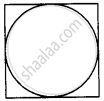
Given, area of square = 100 cm2
∴ Area of square = a2
⇒ a2 = 100 cm2 ...[∵ Area of square = (Side)2]
⇒ a = `sqrt(100)`
⇒ a = 10 cm
Now, for the largest circle in the square, diameter of the circle must be equal to the side of square.
∴ Diameter = Side of a square = 10 cm
⇒ 2r = 10 cm ...[∵ Diameter = 2 × radius]
⇒ r = 5 cm
∴ Circumference of the circle = 2 πr = 2 × π × 5 = 10 π cm.
APPEARS IN
संबंधित प्रश्न
The minute hand of clock is10cm long. Find the area of the face of the clock described by the minute hand between 8am and 8:25 am
Figure, shows a sector of a circle, centre O, containing an angle 𝜃°. Prove that area of the shaded region is `r^2/2(tanθ - (πθ)/180^circ)`.

A wheel has a diameter of 84 cm. Find how many completer revolutions must it make to cover 3.168 km.
In the adjoining figure, the radius is 3.5 cm. Find:
(i) The area of the quarter of the circle correct to one decimal place.
(ii) The perimeter of the quarter of the circle correct to one decimal place. ( Take π = `22/7`)

Complete the table below.
| Radius (r) | Diameter (d) | Circumference (c) |
| ...... | 28 cm | ...... |
Complete the table below.
| Radius (r) | Diameter (d) | Circumference (c) |
| ...... | ...... | 616 cm |
The diameter of a cycle wheel is `4(5)/(11)"cm"`. How many revolutions will it make in moving 6.3km?
The cost of fencing a circular race course at the rate of ₹ 8 per metre is ₹ 2112. Find the diameter of the race course
Find the number of revolutions made by a circular wheel of area 1.54 m2 in rolling a distance of 176 m.
Find the total cost of wooden fencing around a circular garden of diameter 28 m, if 1 m of fencing costs ₹ 300.
