Advertisements
Advertisements
प्रश्न
Ten men take 4 days to complete the task of tarring a road. How many days would 8 men take?
Advertisements
उत्तर
| Number of men | Number of days |
| 10 | 4 |
| 8 | x |
The more men, the fewer the number of days required to finish the work.
So, the number of men and the number of days required to complete the work are inversely proportional to each other.
`10/8 = "x"/4`
`=> "x" = (10 xx 4)/8`
⇒ x = 5
Thus, when 8 men are involved, 5 days will be required.
APPEARS IN
संबंधित प्रश्न
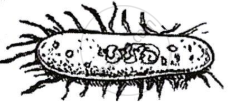
A photograph of a bacteria enlarged 50,000 times attains a length of 5 cm as shown in the diagram. What is the actual length of the bacteria? If the photograph is enlarged 20,000 times only, what would be its enlarged length?
68 boxes of a certain commodity require a shelf-length of 13.6 m. How many boxes of the same commodity would occupy a shelf length of 20.4 m?
11 men can dig \[6\frac{3}{4}\] metre long trench in one day. How many men should be employed for digging 27 metre long trench of the same type in one day?
8 men can do a piece of work in 9 days. In how many days will 6 men do it?
A pipe can fill a cistern in 10 hours. Due to a leak in the bottom it is filled in 12 hours. When the cistern is full, in how much time will it be emptied by the leak?
Two quantities x and y are said to vary directly with each other if for some rational number k, xy = k.
If x and y are in direct proportion, then (x – 1) and (y – 1) are also in direct proportion.
In a camp, there is enough flour for 300 persons for 42 days. How long will the flour last if 20 more persons join the camp?
The mass of an aluminum rod varies directly with its length. If a 16 cm long rod has a mass of 192 g, find the length of the rod whose mass is 105 g.
Match each of the entries in Column I with the appropriate entry in Column II
| Column I | Column II |
| 1. x and y vary inversely to each other | A. `x/y` = Constant |
| 2. Mathematical representation of inverse variation of quantities p and q |
B. y will increase in proportion |
| 3. Mathematical representation of direct variation of quantities m and n |
C. xy = Constant |
| 4. When x = 5, y = 2.5 and when y = 5, x = 10 | D. `p oo 1/q` |
| 5. When x = 10, y = 5 and when x = 20, y = 2.5 | E. y will decrease in proportion |
| 6. x and y vary directly with each other | F. x and y are directly proportional |
| 7. If x and y vary inversely then on decreasing x | G. `m oo n` |
| 8. If x and y vary directly then on decreasing x | H. x and y vary inversely |
| I. `p oo q` | |
| J. `m oo 1/n` |
