Advertisements
Advertisements
प्रश्न
Taking 0.5 cm as 1 unit, plot the following points on the graph paper:
A(1, 3), B(– 3, – 1), C(1, – 4), D(– 2, 3), E(0, – 8), F(1, 0)
Advertisements
उत्तर
Here, in point A(1, 3) both x and y-coordinates are positive, so it lies in I quadrant.
In point B(– 3, – 1), both x and y-coordinates are negative, so it lies in III quadrant.
In point C(1, – 4), x-coordinate is positive and y-coordinate is negative, so it lies in IV quadrant.
In point D(– 2, 3), x-coordinate is negative and y-coordinate is positive, so it lies in II quadrant.
In point E(0, – 8) x-coordinate is zero, so it lies on y-axis and in point F(1, 0) y-coordinate is zero, so it lies on x-axis.

APPEARS IN
संबंधित प्रश्न
Write the coordinates of each of the following points marked in the graph paper:
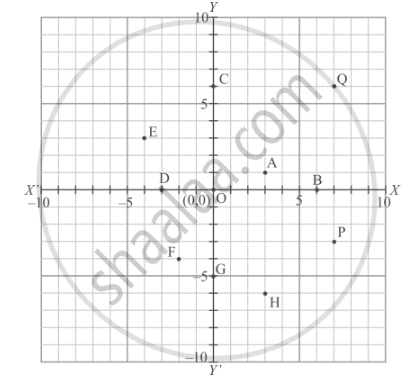
Plot the following point on the graph paper:
(−5, −7)
Write the equation of the line parallel to the Y-axis at a distance of 7 units from it to its left.
Plot the following points on the one and the same co-ordinate system.
A(1, 3), B(-3, -1), C(1, -4), D(-2, 3), E(0, -8), F(1, 0)
Find the quadrants without plotting the point on a graph sheet
(3, −4)
Plot the following point in a graph sheet.
A(5, 2)
Plot the following point in a graph sheet.
C(−2, 4)
Use the graph to determine the coordinates where each figure is located.
| a) Star | _______ |
| b) Bird | _______ |
| c) Red circle | _______ |
| d) Diamond | _______ |
| e) Triangle | _______ |
| f) Ant | _______ |
| g) Mango | _______ |
| h) Housefly | _______ |
| i) Medal | _______ |
| j) Spider | _______ |
Plot the following points and check whether they are collinear or not:
(0, 0), (2, 2), (5, 5)
Which of the following points lie on y-axis?
A(1, 1), B(1, 0), C(0, 1), D(0, 0), E(0, – 1), F(– 1, 0), G(0, 5), H(– 7, 0), I(3, 3).
