Advertisements
Advertisements
प्रश्न
Students of Class VI in a school were given a task to count the number of articles made of different materials in the school.
The information collected by them is represented as follows:
| Material used | Articles  = 20 articles = 20 articles |
| Wood |  |
| Glass |  |
| Metal |  |
| Rubber |  |
| Plastic |  |
Observe the pictograph and answer the following questions:
- Which material is used in maximum number of articles?
- Which material is used in minimum number of articles?
- Which material is used in exactly half the number of articles as those made up of metal?
- What is the total number of articles counted by the students?
Advertisements
उत्तर
The number of articles of different materials is depicted (represented) by the following table
| Material used | Articles | Number of articles |
| Wood | |
20 + 10 = 30 |
| Glass | |
20 |
| Metal | |
20 + 20 + 10 = 50 |
| Rubber | |
20 + 5 = 25 |
| Plastic | |
20 + 15 = 35 |
- Metal is used in the maximum number of articles.
- Glass is used in the minimum number of articles.
- From the pictograph, we observe that 50 articles were made of metal whereas 25 articles were made of rubber, which is exactly half the number of articles as those made up of metal.
- Total number of articles = Articles made of (wood + glass + metal + rubber + plastic)
= 30 + 20 + 50 + 25 + 35
= 160
APPEARS IN
संबंधित प्रश्न
The following pictograph shows the number of watches manufactured by a factory, in a particular weeks.
| Day | Number of watches |
| Monday |       |
| Tuesday |            |
| Wednesday |       |
| Thursday |       |
| Friday |      |
| Saturday |         |
Scale:  = 100 watches
Find the total number of watches manufactured in the whole week?
The number of animals in five villages are as follows:
| Village | A | B | C | D | E |
| No. of. animals | 160 | 240 | 180 | 80 | 120 |
Prepare a pictograph of these animals using one symbol to represent 20 animals.
The following pictograph shows different subject books which are kept in a school library.
| Subject | Number of books |
| Hindi |       |
| English |       |
| Math |      |
| Science |      |
| History |     |
Taking symbol of one book = 50 books, find:
How many History books are there in the library?
The following pictograph shows different subject books which are kept in a school library.
| Subject | Number of books |
| Hindi | |
| English | |
| Math | |
| Science | |
| History | |
Taking symbol of one book = 50 books, find:
How many Science books are there in the library?
Representation of data by using pictures is known as ______________
The following table shows the weight of paddy cultivated in a particular village during the years 2010 to 2015
| Year | Paddy production |
| 2010 |  |
| 2011 |  |
| 2012 |  |
| 2013 |  |
| 2014 |  |
| 2015 |  |
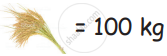
Observe the pictograph and answer the following questions.
a) In which year paddy production was maximum?
b) In which year paddy production were equal?
c) Find the quantity of paddy production in 2015
d) Find the total quantity of paddy production particularly 2013, 2014, and 2015
In a pictograph, if a symbol  represents 50 books in a library shelf, then the symbol
  represents 25 books.
In a pictograph where the scale is 1 picture = 6 runs, how many complete pictures are needed to represent 18 runs?
What does the scale in a pictograph indicate?
A shop sold mobile sets over a week. The pictograph uses 1 mobile icon = 6 sets.
Monday shows 4 icons, Tuesday shows 6 icons, and Wednesday shows 5 icons. How many mobile sets were sold on Tuesday?
