Advertisements
Advertisements
प्रश्न
State two functions of a machine.
Advertisements
उत्तर
Various functions that a machine can perform are:
- Changing the direction of applied force – Example: When a flag is hoisted with the help of a pulley.
- Changing the magnitude of applied force – Example: Bottle opener multiplies the applied force and much less effort is required to open the cap.
- Applying force at a convenient point – Example: In a pair of scissors, the input force is applied at the handle of the scissors which cuts the paper at the other end of the blade.
- Changing the speed of an object – Example: While riding a bicycle, force is applied on pedals which multiplies the speed.
APPEARS IN
संबंधित प्रश्न
From the diagram given below. answer the question that follows:
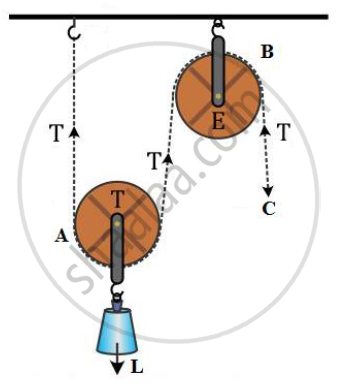
1) What kind of pulleys are A and B?
2) State the purpose of pulley B.
3) What effort has to be applied at C just raise the load L = 20 kgf?
(Neglect the weight of pulley A and friction)
Select the correct alternative:
A pulley is used because of it
What is the justification for using the pulley then ?
Answer the following in detail.
How does a pulley make work simpler?
In a gear system, the gear ration of the driving wheel A and driven wheel B is 10:1. To rotate the driven wheel B in the direction of driving wheel A, the driving wheel A is engaged with other wheel C. what should be the gear ratio of the wheels A and C?
Give reason for the following:
In a single fixed pulley, the velocity ratio is always more than the mechanical advantage.
Write two uses of pulleys. Is pulley a force multiplier?
There is no gain in mechanical advantage in the case of a single fixed pulley. Explain, why the pulley is then used?
State two reasons, why the efficiency of a pulley system is not 100 percent?
Draw a diagram of a single fixed pulley and obtain expressions for its:
(i) Mechanical advantage,
(ii) Velocity ratio, and
(iii) Efficiency, in the ideal case.
