Advertisements
Advertisements
प्रश्न
State Faraday’s Laws of electrolysis.
State and explain Faraday’s laws of electrolysis.
What is Faraday’s first law of electrolysis?
Advertisements
उत्तर १
Faraday’s laws of electrolysis:
- First law: The mass of the substance (M) liberated at an electrode during electrolysis is directly proportional to the quantity of charge (Q) passed through the cell, i.e., M ∝ Q.
- Second law: When the same quantity of charge is passed through the solutions of different electrolytes, the amount of substances liberated at the respective electrodes are directly proportional to their electrochemical equivalents, i.e., M ∝ Z.
उत्तर २
Faraday’s first law of electrolysis: Faraday’s first law of electrolysis may be stated as follows.
The amount of substance liberated (or deposited) at a particular electrode during electrolysis is directly proportional to the quantity of electricity (total charge) passed in the solution.
W ∝ Q
Since Charge = Current × Time
we have Q = I × t
where I is the current (in amperes) passed in the solution for t seconds. Hence,
W ∝ I × t
or, W = Z × I × t ...(i)
In the above equation, Z is a constant known as the electrochemical equivalent of the substance liberated at the electrode.
If I = 1 ampere and t = 1 s, we have
W = Z
Hence, electrochemical equivalent may be defined as the amount of substance liberated by a current of one ampere passed for one second.
Faraday’s second law of electrolysis: Faraday’s second law of electrolysis can be stated as follows.
When the same quantity of electricity is passed through the solutions of different electrolytes connected in series, the masses of the substances liberated (or deposited) at the electrodes are directly proportional to their equivalent masses.
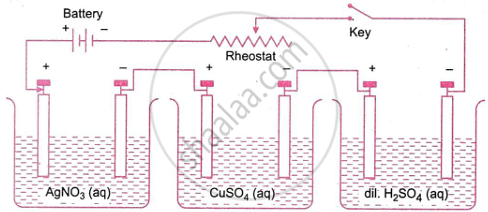
Suppose three voltameters connected in series contain aqueous solutions of silver nitrate, copper sulphate, and dilute sulphuric acid, respectively, as shown in Fig. On passing electric current, electrolysis takes place in all three cells, and the substances produced at the cathodes of these cells are Ag(s), Cu(s), and H2(g), respectively. If the same current is passed for the same time, it is found that
\[\frac{\text{Mass of silver deposited}}{\text{Mass of copper deposited}} = \frac{\text{Equivalent mass of silver}}{\text{Equivalent mass of copper}}\] and,
\[\frac{\text{Mass of hydrogen gas liberated}}{\text{Mass of silver deposited}} = \frac{\text{Equivalent mass of hydrogen}}{\text{Equivalent mass of silver}}\]
Notes
Students should refer to the answer according to their questions and preferred marks.
APPEARS IN
संबंधित प्रश्न
During electrolysis of molten sodium chloride, the time required to produce 0.1 mole of chlorine gas using a current of 3A is ___________.
The number of electrons delivered at the cathode during electrolysis by a current of 1A in 60 seconds is ____________.
(charge of electron = 1.6 × 10⁻¹⁹ C)
Among the following cells
I) Leclanche cell
II) Nickel – Cadmium cell
III) Lead storage battery
IV) Mercury cell
Primary cells are:
In \[\ce{H2 - O2}\] fuel cell the reaction occurs at cathode is:
For the cell reaction
\[\ce{2Fe^{3+}_{( aq)} + 2l^-_{( aq)} -> 2Fe^{2+}_{( aq)} + l2_{( aq)}}\]
\[\ce{E^0_{cell}}\] = at 298 K. The standard Gibbs energy (∆G°) of the cell reactions is:
A current of 1.608A is passed through 250 mL of 0.5 M solution of copper sulphate for 50 minutes. Calculate the strength of Cu2+ after electrolysis assuming volume to be constant and the current efficiency is 100%.
In fuel cell H2 and O2 react to produce electricity. In the process, H2 gas is oxidised at the anode and O2 at cathode. If 44.8 litre of H2 at 25°C and 1 atm pressure reacts in 10 minutes, what is average current produced? If the entire current is used for electro deposition of Cu from Cu2+, how many grams of deposited?
The same amount of electricity was passed through two separate electrolytic cells containing solutions of nickel nitrate and chromium nitrate respectively. If 2.935 g of Ni was deposited in the first cell. The amount of Cr deposited in the another cell?
Given: molar mass of Nickel and chromium are 58.74 and 52 gm−1 respectively.
8.2 × 10¹² litres of water is available in a lake. A power reactor using the electrolysis of water in the lake produces electricity at the rate of 2 × 10⁶ Cs−1 at an appropriate voltage. How many years would it like to completely electrolyse the water in the lake? Assume that there is no loss of water except due to electrolysis.
Derive an expression for the Nernst equation.
