Advertisements
Advertisements
प्रश्न
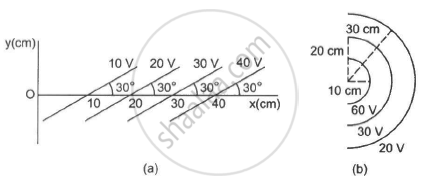
Some equipotential surface is shown in the figure. What can you say about the magnitude and the direction of the electric field?
संख्यात्मक
Advertisements
उत्तर
(a) The electric field is always perpendicular to the equipotential surface. (As shown in the figure)
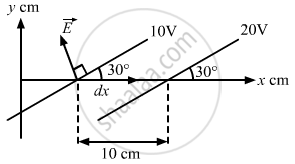
So, the angle between \[\vec{E} \text{ and } \vec{dx}\] = \[90^\circ+ 30^\circ\]
Change in potential in the first and second equipotential surfaces, dV = 10 V
so,
\[\vec{E} . \vec{dx} = - \] dV
\[\Rightarrow \text{ Edx } \cos(90^\circ+ 30^\circ) = - \] dV
\[ \Rightarrow E(10 \times {10}^{- 2} )\cos120^\circ= - 10\]
\[ \Rightarrow E = 200\] V/m
\[ \Rightarrow E(10 \times {10}^{- 2} )\cos120^\circ= - 10\]
\[ \Rightarrow E = 200\] V/m
The electric field is making an angle of 120° with the x axis.
(b) The electric field is always perpendicular to the equipotential surface.
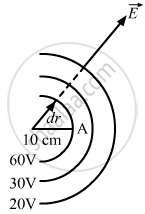
So, the angle between \[\vec{E}\] and \[\vec{dr}\] = 0°
Potential at point A,
\[V_A = \frac{1}{4\pi \epsilon_0}\frac{q}{r} = \] 60 V
\[\Rightarrow \frac{q}{4\pi \epsilon_0} = 60 \times r\]
\[ \Rightarrow \frac{q}{4\pi \epsilon_0} = 6\]
\[ \Rightarrow \frac{q}{4\pi \epsilon_0} = 6\]
So, electric field,
\[E = \frac{q}{4\pi \epsilon_0} \times \frac{1}{r^2} = \frac{6}{r^2}\]
The electric field is radially outward, decreasing with increasing distance.
shaalaa.com
या प्रश्नात किंवा उत्तरात काही त्रुटी आहे का?
