Advertisements
Advertisements
प्रश्न
Solve the following problem.
A lighter object A and a heavier object B are initially at rest. Both are imparted with the same linear momentum. Which will start with greater kinetic energy: A or B or both will start with the same energy?
Advertisements
उत्तर
- Let m1 and m2 be the masses of light object A and heavy objects B and v1 and v2 be their respective velocities.
- Since both are imparted with the same linear momentum,
m1v1 = m2v2 - The kinetic energy of the lighter object A
= K.E.A = `1/2 "m"_1"v"_1^2`
The kinetic energy of the heavier object B
= K.E.B = `1/2 "m"_2"v"_2^2`
∴ `("K.E."_"A")/("K.E."_"B") = (1/2 "m"_1"v"_1^2)/(1/2"m"_2"v"_2^2) = (("m"_1"v"_1)^2//"m"_1)/(("m"_2"v"_2)^2//"m"_2)`
∴ `("K.E."_"A")/("K.E."_"B") = "m"_2/"m"_1` ....[∵ m1v1 = m2v2] - As m1 < m2, therefore K.E.A > K.E.B i.e, the lighter body A has more kinetic energy.
APPEARS IN
संबंधित प्रश्न
Answer the following question.
State the law of conservation of linear momentum. It is a consequence of which law? Give an example from our daily life for the conservation of momentum. Does it hold good during the burst of a cracker?
Solve the following problem.
The figure below shows a block of mass 35 kg resting on a table. The table is so rough that it offers a self-adjusting resistive force 10% of the weight of the block for its sliding motion along with the table. A 20 kg wt load is attached to the block and is passed over a pulley to hang freely on the left side. On the right side, there is a 2 kg wt pan attached to the block and hung freely. Weights of 1 kg wt each, can be added to the pan. Minimum how many and maximum how many such weights can be added into the pan so that the block does not slide along the table?

Ten identical masses (m each) are connected one below the other with 10 strings. Holding the topmost string, the system is accelerated upwards with acceleration g/2. What is the tension in the 6th string from the top (Topmost string being the first string)?
A bullet of mass m moving with velocity v is fired into a wooden block of mass M, If the bullet remains embedded in the block, the final velocity of the system is ____________.
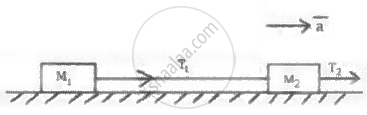
Two masses M1 and M2 are accelerated uniformly on frictionless surface as shown in the figure. The ratio of the tensions `"T"_1/"T"_2` is ______.
If bullet of mass 'm1' is fired from a gun of mass 'm2' with a speed of 'V1', then the recoil velocity of gun is ______.
A body of mass 'M' moving with velocity 'V' explodes into two equal parts. If one part comes to rest and the other part moves with velocity 'v0'. What would be the value of 'v0'?
A firecracker at rest explodes into two fragments of masses m and 2m that fly apart along a line. If the lighter fragment has speed v, what is the speed of the heavier fragment?
A trolley of mass 4 kg moving at 2 m s−1 collides with a stationary trolley of mass 1kg. They stick together. What is their common velocity?
The Principle of Conservation of Linear Momentum is presented as a direct consequence of which fundamental law of motion?
A ball rebounds off a smooth wall with the same speed v but reversed horizontal component. If its mass is m and incidence is normal, what impulse does the wall impart?
A projectile breaks into 3 equal pieces at the top. One drops straight down, one moves left at speed v. What’s the horizontal speed of the third piece?
