मराठी
महाराष्ट्र राज्य शिक्षण मंडळएचएससी वाणिज्य (इंग्रजी माध्यम) इयत्ता १२ वी

Smita is a diet conscious house wife, wishes to ensure certain minimum intake of vitamins A, B and C for the family. The minimum daily needs of vitamins A, B, and C for the family are 30, 20, and 16 - Mathematics and Statistics

Advertisements
Advertisements

प्रश्न

Smita is a diet conscious house wife, wishes to ensure certain minimum intake of vitamins A, B and C for the family. The minimum daily needs of vitamins A, B, and C for the family are 30, 20, and 16 units respectively. For the supply of the minimum vitamin requirements Smita relies on 2 types of foods F1 and F2. F1 provides 7, 5 and 2 units of A, B, C vitamins per 10 grams and F2 provides 2, 4 and 8 units of A, B and C vitamins per 10 grams. F1 costs ₹ 3 and F2 costs ₹ 2 per 10 grams. How many grams of each F1 and F2 should buy every day to keep her food bill minimum

तक्ता
आकृती
Advertisements

उत्तर

Let food F1 be x grams and food F2 be y grams.

Since x and y cannot be negative, x ≥ 0, y ≥ 0.

F1 costs ₹ 3 and F2 costs ₹ 2 per 10 grams.

∴ Total cost = Z = 3x + 2y

We construct a table with constraints of vitamins A, B and C as follows:

Vitamins/Food F1 F2 Minimum requirement
A 7 2 30
B 5 4 20
C 2 8 16

From the table, the constraints are

7x + 2y ≥ 30

5x + 4y ≥ 20

2x + 8y ≥ 16

∴ Given problem can be formulated as follows:

Minimize Z = 3x + 2y

Subject to 7x + 2y ≥ 30

5x + 4y ≥ 20,

2x + 8y ≥ 16, x ≥ 0, y ≥ 0

To draw the feasible region, construct table as follows:

Inequality 7x + 2y ≥ 30 5x + 4y ≥ 20 2x + 8y ≥ 16
Corresponding equation (of line) 7x + 2y = 30 5x + 4y = 20 2x + 8y = 16
Intersection of line with X-axis `(30/7, 0)` (4, 0) (8, 0)
Intersection of line with Y-axis (0, 15) (0, 5) (0, 2)
Region Non-Origin side Non-Origin side Non-Origin side

Shaded portion XABCY is the feasible region, whose vertices are A(8, 0), B and C(0, 15),

B is the point of intersection of the lines 7x + 2y = 30 and 2x + 8y = 16

Solving the above equations, we get

x = 4, y = 1

∴ B ≡ (4, 1)
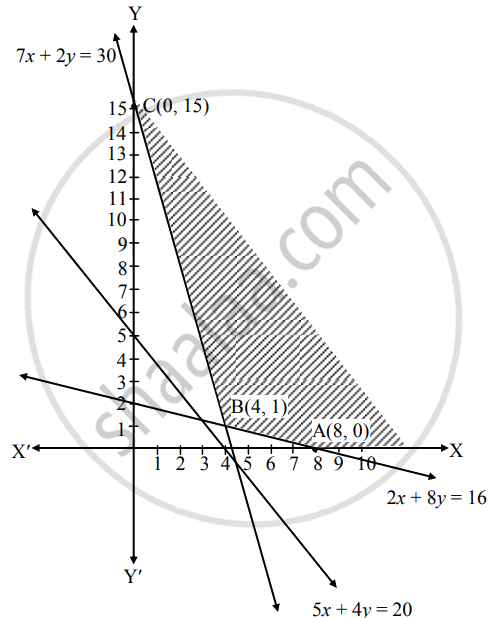
Here, the objective function is

Z = 3x + 2y

Z at A (8, 0) = 3(8) + 2(0) = 24

Z at B (4, 1) = 3(4) + 2(1)

= 12 + 2

= 14

Z at C (0, 15) = 3(0) + 2(15)

= 30

∴ Z has minimum value 14 at x = 4 and y = 1.

∴ Smita should buy 4 grams of food F1 and 1 gram of food F2 every day to keep her food bill minimum.

shaalaa.com
  या प्रश्नात किंवा उत्तरात काही त्रुटी आहे का?
पाठ 2.6: Linear Programming - Q.4 (D)

संबंधित प्रश्‍न

A farmer has a 100 acre farm. He can sell the tomatoes, lettuce, or radishes he can raise. The price he can obtain is Rs 1 per kilogram for tomatoes, Rs 0.75 a head for lettuce and Rs 2 per kilogram for radishes. The average yield per acre is 2000 kgs for radishes, 3000 heads of lettuce and 1000 kilograms of radishes. Fertilizer is available at Rs 0.50 per kg and the amount required per acre is 100 kgs each for tomatoes and lettuce and 50 kilograms for radishes. Labour required for sowing, cultivating and harvesting per acre is 5 man-days for tomatoes and radishes and 6 man-days for lettuce. A total of 400 man-days of labour are available at Rs 20 per man-day. Formulate this problem as a LPP to maximize the farmer's total profit.


The corner points of the feasible region determined by the following system of linear inequalities:
2x + y ≤ 10, x + 3y ≤ 15, xy ≥ 0 are (0, 0), (5, 0), (3, 4) and (0, 5). Let Z = px + qy, where p, q > 0. Condition on p and q so that the maximum of Z occurs at both (3, 4) and (0, 5) is 


A firm manufactures two products, each of which must be processed through two departments, 1 and 2. The hourly requirements per unit for each product in each department, the weekly capacities in each department, selling price per unit, labour cost per unit, and raw material cost per unit are summarized as follows:
 

  Product A Product B Weekly capacity
Department 1 3 2 130
Department 2 4 6 260
Selling price per unit ₹ 25 ₹ 30  
Labour cost per unit ₹ 16 ₹ 20  
Raw material cost per unit ₹ 4 ₹ 4  


The problem is to determine the number of units to produce each product so as to maximize total contribution to profit. Formulate this as a LPP.


Solve the following LPP by graphical method:

Maximize z = 11x + 8y, subject to x ≤ 4, y ≤ 6, x + y ≤ 6, x ≥ 0, y ≥ 0


Solve the following L.P.P. by graphical method:

Maximize: Z = 10x + 25y
subject to 0 ≤ x ≤ 3,
0 ≤ y ≤ 3,
x + y ≤ 5.
Also find the maximum value of z.


Solve the following L.P.P. by graphical method :

Maximize: Z = 3x + 5y subject to x + 4y ≤ 24, 3x + y ≤ 21, x + y ≤ 9, x ≥ 0, y ≥ 0 also find maximum value of Z.


Solve the following L.P.P. by graphical method:

Minimize: Z = 6x + 2y subject to x + 2y ≥ 3, x + 4y ≥ 4, 3x + y ≥ 3, x ≥ 0, y ≥ 0.


Choose the correct alternative:

The value of objective function is maximize under linear constraints.


Fill in the blank :

Graphical solution set of the in equations x ≥ 0, y ≥ 0 is in _______ quadrant


State whether the following is True or False :

The region represented by the inqualities x ≤ 0, y ≤ 0 lies in first quadrant.


Solve the following problem:

Maximize Z = 4x1 + 3x2 Subject to 3x1 + x2 ≤ 15, 3x1 + 4x2 ≤ 24, x1 ≥ 0, x2 ≥ 0


Solve the following problem :

A factory produced two types of chemicals A and B The following table gives the units of ingredients P & Q (per kg) of Chemicals A and B as well as minimum requirements of P and Q and also cost per kg. of chemicals A and B.

Ingredients per kg. /Chemical Units A
(x)
B
(y)
Minimum requirements in
P 1 2 80
Q 3 1 75
Cost (in ₹) 4 6  

Find the number of units of chemicals A and B should be produced so as to minimize the cost.


Solve the following problem :

A person makes two types of gift items A and B requiring the services of a cutter and a finisher. Gift item A requires 4 hours of cutter's time and 2 hours of finisher's time. B requires 2 hours of cutters time, 4 hours of finishers time. The cutter and finisher have 208 hours and 152 hours available times respectively every month. The profit of one gift item of type A is ₹ 75 and on gift item B is ₹ 125. Assuming that the person can sell all the items produced, determine how many gift items of each type should be make every month to obtain the best returns?


Choose the correct alternative:

If LPP has optimal solution at two point, then


Choose the correct alternative:

The maximum value of Z = 3x + 5y subjected to the constraints x + y ≤ 2, 4x + 3y ≤ 12, x ≥ 0, y ≥ 0 is


Choose the correct alternative:

The point at which the minimum value of Z = 8x + 12y subject to the constraints 2x + y ≥ 8, x + 2y ≥ 10, x ≥ 0, y ≥ 0 is obtained at the point


State whether the following statement is True or False:

If the corner points of the feasible region are (0, 10), (2, 2) and (4, 0), then the minimum value of Z = 3x + 2y is at (4, 0)


State whether the following statement is True or False:

The point (6, 4) does not belong to the feasible region bounded by 8x + 5y ≤ 60, 4x + 5y ≤ 40, 0 ≤ x, y


A set of values of variables satisfying all the constraints of LPP is known as ______


A company manufactures two types of ladies dresses C and D. The raw material and labour available per day is given in the table.

Resources Dress C(x) Dress D(y) Max. availability
Raw material 5 4 60
Labour 5 3 50

P is the profit, if P = 50x + 100y, solve this LPP to find x and y to get the maximum profit


Minimize Z = 24x + 40y subject to constraints

6x + 8y ≥ 96, 7x + 12y ≥ 168, x ≥ 0, y ≥ 0


Minimize Z = x + 4y subject to constraints

x + 3y ≥ 3, 2x + y ≥ 2, x ≥ 0, y ≥ 0


Amartya wants to invest ₹ 45,000 in Indira Vikas Patra (IVP) and in Public Provident fund (PPF). He wants to invest at least ₹ 10,000 in PPF and at least ₹ 5000 in IVP. If the rate of interest on PPF is 8% per annum and that on IVP is 7% per annum. Formulate the above problem as LPP to determine maximum yearly income.

Solution: Let x be the amount (in ₹) invested in IVP and y be the amount (in ₹) invested in PPF.

x ≥ 0, y ≥ 0

As per the given condition, x + y ______ 45000

He wants to invest at least ₹ 10,000 in PPF.

∴ y ______ 10000

Amartya wants to invest at least ₹ 5000 in IVP.

∴ x ______ 5000

Total interest (Z) = ______

The formulated LPP is

Maximize Z = ______ subject to 

______


Shraddho wants to invest at most ₹ 25,000/- in saving certificates and fixed deposits. She wants to invest at least ₹ 10,000/- in saving certificate and at least ₹ 15,000/- in fixed deposits. The rate of interest on saving certificate is 5% and that on fixed deposits is 7% per annum. Formulate the above problem as LPP to determine maximum income yearly.


Share
Notifications

Englishहिंदीमराठी


      Forgot password?
Use app×