Advertisements
Advertisements
प्रश्न
Sketch and label stages in the development of the angiospermic female gametophyte from the functional megaspore.
Advertisements
उत्तर
In angiosperms, the female gametophyte, also known as the embryo sac, develops from the functional megaspore through a process called megagametogenesis.
Stages of development:
-
Functional megaspore (Haploid): Out of the four megaspores formed after meiosis of the megaspore mother cell, only one (usually the chalazal one) remains functional, while the other three degenerate.
-
Two-nucleate stage: The nucleus of the functional megaspore divides mitotically to form two haploid nuclei, which migrate to opposite poles of the cell.
-
Four-nucleate stage: Both nuclei divide again mitotically to form four nuclei, two at each pole.
-
Eight-nucleate stage (Mature embryo sac): A final mitotic division produces eight nuclei, four at each pole.
-
The egg apparatus is made up of three nuclei at the micropylar end: one egg cell and two synergids.
-
Three nuclei at the chalazal end make up antipodal cells.
-
Two nuclei move to the center and fuse to form the secondary (polar) nucleus.
-
Thus, the mature embryo sac becomes seven-celled and eight-nucleate.
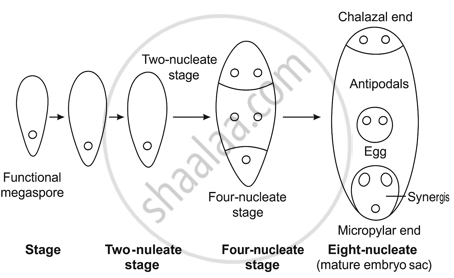
Development of Female Gametophyte (Embryo Sac)
APPEARS IN
संबंधित प्रश्न
Define Racemose inflorescence
Explain the events upto double fertilisation after the pollen tube enters one of the synergids in an ovule of an angiosperm.
Explain the different types of endosperms in angiosperms.
A typical flower has ______ different kinds of whorl.
Science of cultivation, breeding, marketing and arrangement of flowers is called ______.
Pollen grains are well preserved as fossils because of the presence of ______
Match List I with List II:
| List I (Types of Stamens) |
List II (Example) |
||
| A. | Monoadelphous | I. | Citrus |
| B. | Diadelphous | II. | Pea |
| C. | Polyadelphous | III. | Lily |
| D. | Epiphyllous | IV. | China-rose |
Choose the correct answer from the options given below:
A flower is biologically defined as a modified and compressed _______.
The male reproductive unit of a flower, the androecium, is made up of individual members called ______.
What is the main function of the corolla?
