Advertisements
Advertisements
प्रश्न
Simplify:
`(((-2)/3)^-2)^3 xx (1/3)^-4 xx 3^-1 xx 1/6`
Advertisements
उत्तर
Using laws of exponents,
(am)n = (a)m × n, `a^-m = 1/a^m`, am × an = am + n and am ÷ an = am – n ...[∵ a is non-zero integer]
∴ `(((-2)/3)^-2)^3 xx (1/3)^-4 xx 3^-1 xx 1/6 = ((-2)/3)^((-2) xx 3) xx (3)^4 xx 1/3 xx 1/6`
= `((-2)/3)^-6 xx 3^4 xx 1/3 xx 1/(2 xx 3)` ...[∵ 6 = 2 × 3]
= `(3/(-2))^6 xx 3^4 xx 1/(3 xx 2 xx 3) `
= `(3)^6/(-2)^6 xx 3^4 xx 1/(2^1 xx 3^2)`
= `(3)^(6 + 4)/((2)^(6 + 1) xx 3^2)` ...[(–am) = am, If m is an even number]
= `(3)^10/(2^7 xx 3^2)`
= `3^(10 - 2)/2^7`
= `3^8/2^7`
APPEARS IN
संबंधित प्रश्न
(–9)3 ÷ (–9)8 is equal to ______.
By solving (60 – 70) × (60 + 70) we get ______.
(–2)0 = 2
`(-8/2)^0 = 0`
`(16 xx 10^2 xx 64)/(2^4 xx 4^2)`
A new born bear weighs 4 kg. How many kilograms might a five year old bear weigh if its weight increases by the power of 2 in 5 years?
Find a single repeater machine that will do the same work as hook-up.

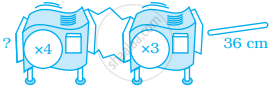
Supply the missing information for diagram.
If possible, find a hook-up of prime base number machine that will do the same work as the given stretching machine. Do not use (× 1) machines.

The diameter of the Sun is 1.4 × 10⁹ m and the diameter of the Earth is 1.2756 × 10⁷ m. Compare their diameters by division.
