Advertisements
Advertisements
प्रश्न
Show the refraction of light wave at a plane interface using Huygens’ principle and prove Snell’s law.
Advertisements
उत्तर
Consider a plane wavefront incident from medium 1 (refractive index n1, speed of light v1) onto a plane boundary with medium 2 (refractive index n2, speed of light v2).
At an angle of incidence i, the incident wavefront gets closer to the boundary.
The refracted wavefront moves in medium 2 with an angle of refraction r.
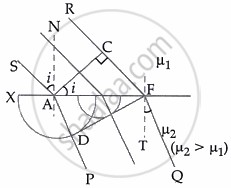
Applying Huygens’ Principle:
Wavefront in Medium 1:
Consider a wavefront AC moving towards the interface.
Each point on AC acts as a secondary source, emitting wavelets.
Wavefront in Medium 2:
When point A hits the interface, it immediately starts producing secondary wavelets in the second medium.
After time t, point C reaches the interface at point F, and secondary wavelets in the second medium form the new wavefront DF.
Derivation of snell’s law:
From the geometry of the wavefront:
Distance travelled by the incident wavefront in medium 1:
AC = v1t
Distance travelled by the refracted wavefront inmedium 2:
DF = v2t
The incident and refracted wavefronts make angles i and r with the interface, so:
sin i = `(AC)/(AF)`
= `(v_1t)/(AF)` ...(i)
sin r = `(AD)/(AF)`
= `(v_2t)/(AF)` ...(ii)
On solving equations (i) and (ii):
`(sin i)/(sin r) = v_1/v_2`
Since the refractive index is defined as n = `c/v`,
Where c is the speed of light in a vacuum:
`v_1/v_2 = n_2/n_1`
Thus, we get Snell’s law:
n1 sin i = n2 sin r
