Advertisements
Advertisements
प्रश्न
Show that vectors `vec a = 2 hat i + 5 hat j - 6 hat k` and `vec b = hat i + 5/2 hat j - 3 hat k` are parallel.
Advertisements
उत्तर
Let the angle between the two vectors be θ.
∴ cos θ = `(vec a * vec b)/(|vec a| |vec b|)`
= `((2 hat i + 5 hat j - 6 hat k) * (hat i + 5/2 hat j - 3 hat k))/(sqrt (2^2 + 5^2 + (-6)^2) xx sqrt(1^2 + (5/2)^2 + (-3)^2))`
= `(2 + 25/2 + 18)/(sqrt 65 xx sqrt (65//4))`
= `(65//2)/(65//2)`
= 1
⇒ θ = cos−1 (1) = 0°
⇒ Two vectors are parallel.
Alternate method:
`vec a = 2 hat i + 5 hat j - 6 hat k = 2 (hat i + 5/2 hat j - 3hat k) = 2 vec b`
Since `vec a` is a scalar multiple of `vec b`, the vectors are parallel.
APPEARS IN
संबंधित प्रश्न
`hati "and" hatj` are unit vectors along x- and y-axis respectively. What is the magnitude and direction of the vectors `hati+hatj` and `hati-hatj` ? What are the components of a vector `A = 2hati + 3hatj` along the directions of `hati + hatj` and `hati - hatj` ? [You may use graphical method]
Answer the following question.
Show that `vec"a" = (hat"i" - hat"j")/sqrt2` is a unit vector.
Answer the following question.
If `vec"v"_1 = 3hat"i" + 4hat"j" + hat"k" and vec"v"_2 = hat"i" - hat"j" - hat"k"`, determine the magnitude of `vec"v"_1 + vec"v"_2`.
For `vec v_1 = 2 hat i - 3 hat j` and `vec v_2 = -6hat i + 5 hat j`, determine the magnitude and direction of `vec v_1 + vec v_2`.
Determine `veca xx vecb`, given `veca = 2hati + 3hatj and vecb = 3hati + 5hatj`.
Walking of a person on the road is an example of
Figure shows the orientation of two vectors u and v in the XY plane.
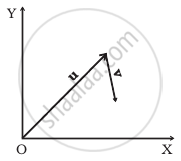
If `u = ahati + bhatj` and `v = phati + qhatj`
which of the following is correct?
The component of a vector r along X-axis will have maximum value if ______.
What is the process of splitting a single vector into two or more vectors along specific directions called?
What is the defining feature of rectangular components of a vector?
A vector \[\vec V\] = 3î + 4ĵ. What is the magnitude of this vector?
What is the result of dividing a non-zero vector \[\vec V\] by its own magnitude ∣\[\vec V\]∣?
The unit vector parallel to the resultant of the vectors \[\vec A\] = 4\[\hat i\] + 3\[\hat j\] + 6\[\hat k\] and \[\vec B\] = -\[\hat i\] + 3\[\hat j\] - 8\[\hat k\] is ______.
The component of a vector may be ______.
The vector projection of a vector 3\[\hat i\] + 4\[\hat k\] on Y-axis is ______.
A vector is represented by 3\[\hat i\] + \[\hat j\] + 2\[\hat k\]. Its length in XY plane is ______.
A particle is simultaneously acted by two forces equal to 4 N and 3 N. The net force on the particle is ______.
